%20(1).jpg)


This article is a transcribed, edited summary of a video Bob and Brad recorded in April 2025. For the original video, watch "Best Remedies for Swollen Feet.' https://youtu.be/RdhLiQiYHIc
Mike: Today, we're talking about something a lot of people deal with, especially as they age, and that is swollen feet.
Brad: That's right. Whether it's from sitting too long, standing too long, or you have circulation issues in your leg, we are going to show three different ways to help, and they're the best ways you can do it at home by yourself.
Mike: So before we give the three tips, we want you to understand why your feet are swelling. Now, when it comes to basic blood flow in the legs, we have arteries which carry blood away from the heart, and then we have veins which return the blood back up, and oftentimes, we have issues with your veins returning the blood back up.
Brad: That's right, there's also lymphedema that brings fluid up, and that all works together with this, but we're not going to get in the weeds too much; we're going to go look at the veins that rely on two different mechanisms to move the blood upward. What's the first one?
Mike: The first one is simple muscle contraction, and that can be in any part of your leg if you're dealing with, obviously, swollen feet, so that can include the calf muscles, the hamstrings, the quads, any of the thigh muscles; getting contraction can help bring circulation of blood flow back up through the veins. What's the next one?
Brad: The next one is simply gravity!
Mike: Gravity.
Brad: I just broke our table. Don't worry about it; I can fix it. I can fix anything except for a broken heart. Anyways, let's get on with the program. Obviously, gravity is effective, as proven here, and that will definitely help circulation in your leg.
Mike: Now, why are you having swollen legs? This could be due to some other type of medical issues, which you want to get cleared by a doctor, obviously, but things like prolonged sitting or prolonged standing, being in one position, not moving, getting that muscle contraction, and gravity just pulling everything to your feet is a big component, or pulling Brad's butt on the bench and breaking it.
Brad: There you go. See how everything works together? Let's go on and just show remedy number one.
Mike: Remedy number one is simply elevating your legs up on a surface. Brad has a chair, and he is lying on the ground, and also doing some ankle pumps so we get the muscle contraction. With this, we are eliminating gravity by lying down, and we're getting the muscle contraction with the ankle pumps.
Mike: You can also do this in bed. Just take a couple of pillows, place them under your legs, and then you can do ankle pumps. We recommend doing 30 repetitions total. You can do 10 repetitions and rest, and do that three times, or two sets of 15, or all 30 at once; it doesn't really matter. If you find this beneficial and you want to use something like a leg wedge pillow, you can certainly do that. They are relatively inexpensive; there are many brands. Just make sure to get the leg wedge, and you don't want the triangle-shaped one for your upper body because they are not the same thing.
Brad: Right, they're very comfortable as well; again, pillows work well. Mike, should we continue on?
Mike: Yeah, so we can go to tip number two. Tip number one, obviously, you didn't really need to purchase anything unless you really want a leg wedge, but tip number two is actually massaging your feet to get some circulation in the area. Now, if you know someone like Brad and they can just rub your feet for you, you can certainly try that.
Brad: Yeah, I wouldn't touch your foot with a 10-foot pole, but yeah, you can do your own feet or, you know, maybe if you're real lucky, someone at home will do it for you. This is how I like to get my feet, like this, thumbs on the bottom, and, first, work those toes, we're want to start distal and work upwards towards the knee, I'm going to simply work those toes back and forth, this is also good for those joints, especially if you have a little arthritis in your feet, get the motion going, and then, work this, and you see I'm moving the massage and the direction of the fluid flow, we want it going upwards towards the heart, there we go, now, this will take a little energy and wear your hands out after a while, but, you know, if you don't have anything else, it will work. You can buy a foot massager. Look at that, it's a Bob and Brad one.
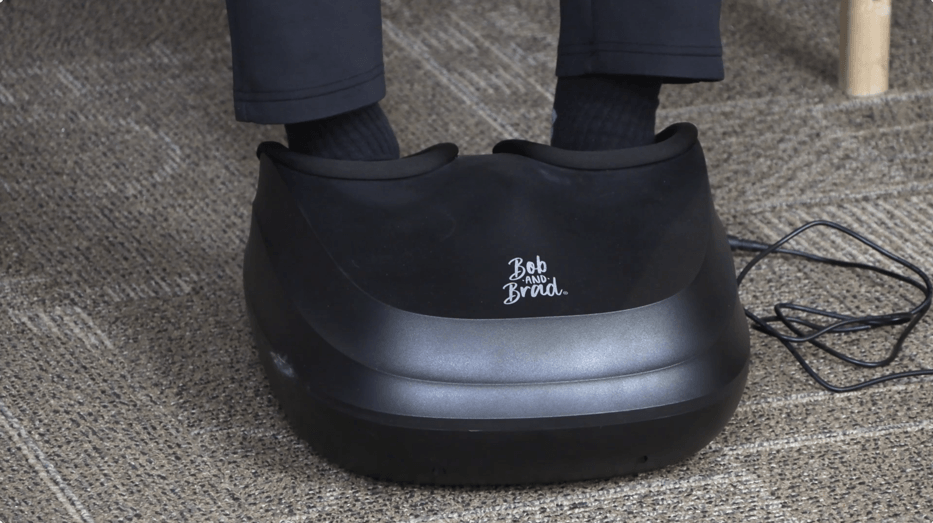
Mike: Yeah, this is the Bob and Brad Lite Foot Massager. We have another model; it's a little bigger, but I like this thing a lot. You just put your feet in there; you can have some heat settings, and you can adjust the intensity. There's kind of, like, an air bladder in there causing a little bit of compression, which can help get that swelling out of your feet, obviously, this isn't going to do much for your calf swelling in that region, but it is a good option that you can try. And this is more for, you know, just swollen legs. If you have lymphedema, you really want to go see a specialist for that because that's a totally different technique.
Brad: Yeah, and as far as the compression on there, it's got three different settings. And the third one, I think, is pretty strong.
Mike: You can even turn off the compression if you don't want it. This one has a nice remote too. I don't even have to bend over.
Brad: Yep, that is a good deal, no doubt about it.
Mike: Now, the last tip, again, is something you may want to clarify with your physician if you have really bad swelling in your legs or lymphedema, but that is compression socks or compression garments of sorts. There are ones you can simply buy online, or there are medical-grade ones which you need to go see a practitioner and get measured properly for the right size for you.
Brad: Right, so the thing with compression socks is they have a little more compression around the foot and ankle, and it gets less compression around the calf, and that is to allow the circulation to move upward. They do give it a number; they give the compression in millimeters of mercury, oftentimes, a beginner one... Or for most people, it's about 20 or 25 millimeters of compression at the toes. Then it's going to be down to 15 around the calf. Now, if you do have some serious lymphedema, you should see a doctor, and they can make recommendations. If you just have a little bit of swelling or you have some circulation problems, you can probably go online and buy some of the basic ones. Now, I have some nice blue socks, and by the way, this is a new shirt. If you're a regular watcher, I've been wearing the same shirts for five years, and my wife has had enough of it, so she bought me this one today, and we didn't even comment on it.
Mike: She said, "And you had enough of the mat today."
Brad: Yeah, so putting these on is typically not easy because they're tight. Once you get them on, they're typically okay as long as you bought the right size, so if you go like this and you start like a regular sock, and then, you're going to fight, and it might make you say bad words, and we do not want any of that; this is a family show, and we want to keep that at your house as well.
Mike: "Oh, Fuddruckers."
Brad: Yeah, Mike did it okay, though.
Mike: These aren't too bad; I've had some that are a little tighter than this, and they're harder to get on.
Brad: Yeah, yeah, I had bought my parents some.
Mike: Medical-grade ones are a lot harder to get on; I will admit that I struggle with those.
Brad: Yeah, you interrupted me.
Mike: Sorry, go ahead.
Brad: I interrupt him all the time, though; I guess I get it back. And my parents say they had a hard time getting them on, they said, "No way, we're not using those, it's too much work in the morning," but if you get one of these donners, it's a sock donner, this was Bob's actually, so the neat thing about it is it works really good, so you simply take it, go like this, dude, you know, it takes a little bit of practice, but once you do it twice, maybe three times if you're a little slow, you're good, so we go like that, you put your foot in there, and voilà!
Mike: Magic.
Brad: I'm a happy person. Yeah, it's really nice, and they make a couple different styles of these; I think they all work about the same. I don't even know who made that one. This feels really nice.
Mike: So to review everything we talked about, first, if you're having a lot of swelling, try simply elevating your legs with pillows, lying down and doing some ankle pumps, because that's free to do. If you're not noticing much, you could certainly try a foot massager or wearing compression socks. I would say if you're stuck in a seated or standing position all day long, the foot massager- you're not going to be able to stand in it- but socks you can wear while standing, so it would be a good option. If you're sitting at work a lot, Bob ran his foot massager while we filmed all the time.
Brad: Yeah, he did. But, you know, there are also the full-length leg compression devices.
Mike: Oh, yeah, for inflation and improving circulation, yeah, that's more of a recovery tool for muscle swelling.
Brad: But they use them for this as well. My mother was going to get fitted for one, actually, but some things happened. That's not part of this; we'll do that in another video.
Mike: Anyway, if you have any tips for your swollen legs, feel free to comment down below, and if you want to check out more videos on lymphedema, watch "Best Leg Circulation With Lymphedema - Biggest Problem BUT Easiest To Fix!"
Brad: There you go, I tried not to interrupt much this time. He did a lot... Most of the talking, didn't he?
Mike: I did, I blabbed a little bit.
Brad: There you go, thanks a lot, have a good day, and just remember, we can fix just about anything except for...
Mike: A broken heart, but hopefully we can fix this mat table.
Brad: Well, we'll work on this first; if that works, we'll go to the heart; we'll use this table for it.
Mike: And maybe glue will work for a heart too.
Brad: Yeah, you need to get some good waterproof glue; Elmer's works really well, I like it anyways.
Mike: Good to know.
Brad: Take care, be careful.
Medical Disclaimer: All information, content, and material on this website are for informational purposes only and are not intended to serve as a substitute for the consultation, diagnosis, and/or medical treatment of a qualified physician or healthcare provider.
Affiliate Disclaimer: Keep in mind that we may receive commissions when you click our links and make purchases. However, this does not impact our reviews and comparisons. We are highly selective in our products and try our best to keep things fair and balanced to help you make the best choice for you.