top of page

Join our SMS & Email List - VIP Deals Start Here - Join our SMS & Email List - VIP Deals Start Here - Join our SMS & Email List - VIP Deals Start Here - Join our SMS & Email List - VIP Deals Start Here - Join our SMS & Email List - VIP Deals Start Here - Join our SMS & Email List - VIP Deals Start Here - Join our SMS & Email List - VIP Deals Start Here - Join our SMS & Email List - VIP Deals Start Here - Join our SMS & Email List - VIP Deals Start Here - Join our SMS & Email List - VIP Deals Start Here - Join our SMS & Email List - VIP Deals Start Here - Join our SMS & Email List - VIP Deals Start Here - Join our SMS & Email List - VIP Deals Start Here - Join our SMS & Email List - VIP Deals Start Here - Join our SMS & Email List - VIP Deals Start Here - Join our SMS & Email List - VIP Deals Start Here - Join our SMS & Email List - VIP Deals Start Here - Join our SMS & Email List - VIP Deals Start Here - Join our SMS & Email List - VIP Deals Start Here - Join our SMS & Email List - VIP Deals Start Here - Join our SMS & Email List - VIP Deals Start Here - Join our SMS & Email List - VIP Deals Start Here - Join our SMS & Email List - VIP Deals Start Here - Join our SMS & Email List - VIP Deals Start Here - Join our SMS & Email List - VIP Deals Start Here - Join our SMS & Email List - VIP Deals Start Here - Join our SMS & Email List - VIP Deals Start Here - Join our SMS & Email List - VIP Deals Start Here - Join our SMS & Email List - VIP Deals Start Here - Join our SMS & Email List - VIP Deals Start Here - Join our SMS & Email List - VIP Deals Start Here - Join our SMS & Email List - VIP Deals Start Here - Join our SMS & Email List - VIP Deals Start Here - Join our SMS & Email List - VIP Deals Start Here - Join our SMS & Email List - VIP Deals Start Here - Join our SMS & Email List - VIP Deals Start Here - Join our SMS & Email List - VIP Deals Start Here - Join our SMS & Email List - VIP Deals Start Here - Join our SMS & Email List - VIP Deals Start Here - Join our SMS & Email List - VIP Deals Start Here - Join our SMS & Email List - VIP Deals Start Here - Join our SMS & Email List - VIP Deals Start Here - Join our SMS & Email List - VIP Deals Start Here - Join our SMS & Email List - VIP Deals Start Here - Join our SMS & Email List - VIP Deals Start Here - Join our SMS & Email List - VIP Deals Start Here - Join our SMS & Email List - VIP Deals Start Here - Join our SMS & Email List - VIP Deals Start Here - Join our SMS & Email List - VIP Deals Start Here - Join our SMS & Email List - VIP Deals Start Here

Published On 
Time To Read
Share on Socials

Jul 28, 2026

8

More Resources

5 Easy Sciatica Exercises for Fast Relief

How to Mobilize Wrists

How to Sit Pain-Free at Your Desk All Day

Popular Tags

Bob and Brad

at home exercises

Physical Therapy

back pain

Decrease pain

Shoulder pain

back pain relief

Knee health

Pain management

Massage gun

Neck pain

Stretching

Bob and Brad Recommend

Bob and Brad Booyah Stik

$49.95

This article is a transcribed, edited summary of a video Bob and Brad recorded in March 2025. For the original video, go to https://www.youtube.com/watch?v=R4uYPBMovg4


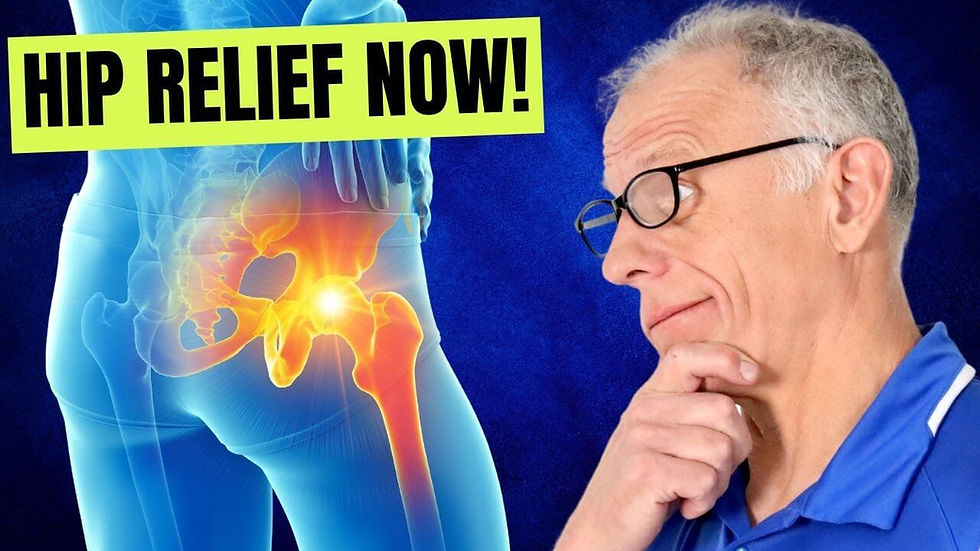
Mike: Do you have extreme hip pain that just won't go away, and you want to get results quickly?


Brad: Well, you're in luck, because we're going to show you two proven methods that clinically have worked for us, as well as a new treatment from a different angle, if you will.


Mike: Literally, a different angle. So, we're actually going to go back in time and take a clip from an older video, with Bob and Brad in it, explaining one treatment option. What's that one?


Brad: Well, this one is actually a decompression technique that you can do at home. Now, this is an interesting video from past times, because actually, we pull Bob out of the scene. Bob becomes the cameraman. And Liz, the camera person, becomes the patient. She does an excellent job; it has gotten millions of views.


Mike: So, after that clip, make sure to stay tuned, because when we come back here, we're going to show you another tip from our friend Rick Olderman, who is a world-renowned Physical therapist.


Brad: Yes, he is well respected. Now these techniques are going to be particularly helpful if you have hip arthritis, labrum issues, or even a subluxed hip.


Mike: So I think we'll go back in time, you ready?


Brad: Yep.

Brad: So, and I mentioned this is relatively easy. And to do this, we're going to get Liz to volunteer to be our patient.


Bob: Yeah, two of them, I would say two of them are easy. One of them you'd probably need a therapist or clinic professional to do.


Brad: Yeah, probably for the clinic. But we'll show you.


Bob: Yeah, we'll show it to you anyway.


Brad: You bet.


Bob: We'll give you the whole schmear.


Brad: All right, we're going to switch places. Okay, now I would expect you'll see the camera shaking and everything else going on with Bob back there, but just be patient.


Bob: That's right.


Brad: Everything will work out.


Bob: A rookie, I already shook it.


Brad: Okay, now Liz isn't miked up, so she may talk but you may not hear her. It's not that we don't want to hear her, but for this purpose, this is okay. Are you ready, Bob?


Bob: I'm ready, let's roll it.


Brad: Okay, so, with the person lying down, you could do it on the floor; it's kind of hard. On a bed, it works; it's the best place, just like this. Liz will be completely relaxed. Her right hip is the one with pain. When she walks on, it goes up and down steps, she usually gets that sharp pain. Simply what you're going to do is have the person relax and grab the ankle. And what I'll just kind of do is wiggle the leg a little bit to make sure they're relaxed and not tense. And then gently pull away from them, so we're putting traction on it. So, and I'll do this and say How does that feel with a little pressure? I mean, just a little bit. And if the person says, "oh, that feels kind of good," then I'll pull a little bit more. I'm never going to get to the point where I'm pulling aggressively.

Bob: And I, but I want to make sure that people know too, you would never do this with a total hip replacement.


Brad: Right, right. This is someone you wouldn't have arthritis in a total hip. So, if it's a total hip, it's time to go to the doctor.


Bob: Right, right.


Brad: And get the orthopedic surgeon to look at it. They'll probably take X-rays and whatnot. So I'll do that. Sometimes I'll pull on it, but it really won't respond well. So then I'll take the toes and the leg and internally rotate it slightly, just a little bit. Not going to twist hard, just a little bit till it stops. And then I'll pull again and see how it responds there. And then I may go the other direction, because sometimes one direction, either inward or outward, can make a big difference in the reduction in pain.

Bob: Yes, it can take away the pain.


Brad: Yeah, abolish it, Bob. And if none of those work, then I'll do this, and I'll abduct or go out to the side a little bit, and then I'll put a little traction on it. And also, I can rotate outward or inward, gently. And all this is gentle. You do not need to pull hard. If it's going to work, it's going to work really well, and the person will say, " Oh, that feels good." And then I've done it where I've just held people there for 30 seconds until I get too tired, and then I'll relax. And it can be really beneficial.

Brad: If that works, and it's time for the person to go home, and they don't have anybody at home that can reproduce the treatment, I'll have them do the next one. If they have a stairway or a stool at home, now, Liz, we're going to say it's her left hip so you can see it, yep. Liz, I want you to stand here with your sore leg. You're going to stand up on your step and hold onto the rail, or here we got the booyah stick, just because it's here and it works well, and really relax this leg, okay? And once you get it relaxed, that's the traction. The weight of your leg is the traction, like me pulling, and then you're going to swing it forward and backwards gently. This is like the pendulum exercise for the shoulders, almost identical. Now you can put an ankle weight on if it feels better.

Bob: And that's what Liz has in place right there.


Brad: That's what this orange is. Now, a lot of people don't have an ankle weight, but if you happen to live in a northern climate as we do, you can just put a pair of winter boots on. They weigh about a pound or two. Or steel-toe boots. If someone has some steel-toe boots, anything gets some weight. And the idea is to relax that leg and just swing it forward and backwards; there you go. How does that feel, Liz? She says it's incredible.


Bob: So Liz could have Wesley hang on her leg there. She's got a little 3-year-old. You know how they hold onto your legs when you try to walk?


Brad: Oh yeah, yeah, that would be good.


Brad: Alright, so you just saw a technique of traction, whether standing or lying down with another person. We're going to show exactly what's going on with that hip joint. So if we look closely here at the ball of the hip, when someone is lying down, we put some distal traction, we're going to pull the hip this way, and we're exaggerating the movement, of course. But when you pull this way, and you have some problems, if that decreases the pain, it works very well. So there's relative motion this way. And then you can see we did a little rotation in the video. I'm not going to get too much more detailed.

Brad: Now this next technique, as we mentioned earlier in the video, actually pulls the joint in a different angle, literally. So we're going to actually move the hip backwards. There's a syndrome called...


Mike: Anterior femoral glide syndrome.


Brad: Thank you. And then what happens is the ball of the hip goes too far forward, and we need to pull it back, so it goes into the socket appropriately and decreases pain. Mike, can you show them how we do that?


Mike: So for this, you can try it with a belt at home, or if you happen to have some sort of large resistance band, you can use that as well. So you're going to need something sturdy to tie it to. So we have some stairs here. Brad, you may have to stand on this. I feel like I'm going to pull it over.


Brad: Yep, I'll help you out with it.


Mike: Our stairs move. Yours shouldn't at home. Anyway, so all I'm gonna do is face forward, and if I want to get that femoral head or my bone right here back in the socket, like Brad was saying, I just lean forward, and this band is going to pull it back. So you're going to relax, have my feet staggered like this, lean forward, have a good upright posture, and this should feel good. If this hurts, then this stretch is not for you. But go forward and lean. I try to do repetitions with this, personally. If you'd rather just kind of sit here, you can do that as well, for a prolonged period of time.

Mike: Now you can also get a different angle if you go sideways, and then you pull; this is more of a distress. Oh, look at that, I could pull you right over. I'm pretty strong, anyway. Yeah, I just go this way, and sometimes this feels good too.

Brad: Now, I would say you probably may not have a strap like this, but if you have a belt from a larger person, or two belts that you could put together, you can also use one of these loop bands, the heavier one. The difference is, as you can see, there's some give to it.

Mike: I like that; I like the give; it feels nice. You can kind of rock; I like to rock into it then when I have this, and I really like to exaggerate it and almost lunge forward and get that leg way back there. But this is just me, personally. I don't have any extreme hip pain right now.


Brad: But you did that one time.


Mike: Oh, I still get some hip pain periodically.


Brad: Right.


Mike: I get a grumpy hip.


Brad: But these techniques you actually use for yourself personally.


Mike: Yeah, they always feel good whenever I do these. I feel relief from tension afterwards. I have to keep doing my other exercises too. But this gets you out of the discomfort zone right away.


Brad: There you go. Alright, nice work.


Mike: You may look out before I slingshot this at you.


Brad: I know your tricks. Alright, what else do we have?


Mike: We have another video if you're still having some hip pain, because in this one, it's more about getting some stretch and pain relief. So you can watch "3 Miracle Exercises For Hip Pain" if you want another option.


Brad: It definitely gives you some options for that hip pain. Hip pain is a bummer. Have a good day and be careful.


Medical Disclaimer: All information, content, and material on this website are for informational purposes only and are not intended to serve as a substitute for the consultation, diagnosis, and/or medical treatment of a qualified physician or healthcare provider.


Affiliate Disclaimer: Keep in mind that we may receive commissions when you click our links and make purchases. However, this does not impact our reviews and comparisons. We are highly selective in our products and try our best to keep things fair and balanced to help you make the best choice for you.

Learn physical therapist-approved hip pain relief techniques, including gentle hip traction and joint decompression exercises, that may help reduce pain from hip arthritis, labral tears, and hip impingement naturally.

Extreme Hip Pain Gone INSTANTLY! (Updated)

Extreme Hip Pain Gone INSTANTLY!  (Updated)

Extreme Hip Pain Gone INSTANTLY! (Updated)

  • Jul 28
  • 8 min read

This article is a transcribed, edited summary of a video Bob and Brad recorded in March 2025. For the original video, go to https://www.youtube.com/watch?v=R4uYPBMovg4


Mike: Do you have extreme hip pain that just won't go away, and you want to get results quickly?


Brad: Well, you're in luck, because we're going to show you two proven methods that clinically have worked for us, as well as a new treatment from a different angle, if you will.


Mike: Literally, a different angle. So, we're actually going to go back in time and take a clip from an older video, with Bob and Brad in it, explaining one treatment option. What's that one?


Brad: Well, this one is actually a decompression technique that you can do at home. Now, this is an interesting video from past times, because actually, we pull Bob out of the scene. Bob becomes the cameraman. And Liz, the camera person, becomes the patient. She does an excellent job; it has gotten millions of views.


Mike: So, after that clip, make sure to stay tuned, because when we come back here, we're going to show you another tip from our friend Rick Olderman, who is a world-renowned Physical therapist.


Brad: Yes, he is well respected. Now these techniques are going to be particularly helpful if you have hip arthritis, labrum issues, or even a subluxed hip.


Mike: So I think we'll go back in time, you ready?


Brad: Yep.

Brad: So, and I mentioned this is relatively easy. And to do this, we're going to get Liz to volunteer to be our patient.


Bob: Yeah, two of them, I would say two of them are easy. One of them you'd probably need a therapist or clinic professional to do.


Brad: Yeah, probably for the clinic. But we'll show you.


Bob: Yeah, we'll show it to you anyway.


Brad: You bet.


Bob: We'll give you the whole schmear.


Brad: All right, we're going to switch places. Okay, now I would expect you'll see the camera shaking and everything else going on with Bob back there, but just be patient.


Bob: That's right.


Brad: Everything will work out.


Bob: A rookie, I already shook it.


Brad: Okay, now Liz isn't miked up, so she may talk but you may not hear her. It's not that we don't want to hear her, but for this purpose, this is okay. Are you ready, Bob?


Bob: I'm ready, let's roll it.


Brad: Okay, so, with the person lying down, you could do it on the floor; it's kind of hard. On a bed, it works; it's the best place, just like this. Liz will be completely relaxed. Her right hip is the one with pain. When she walks on, it goes up and down steps, she usually gets that sharp pain. Simply what you're going to do is have the person relax and grab the ankle. And what I'll just kind of do is wiggle the leg a little bit to make sure they're relaxed and not tense. And then gently pull away from them, so we're putting traction on it. So, and I'll do this and say How does that feel with a little pressure? I mean, just a little bit. And if the person says, "oh, that feels kind of good," then I'll pull a little bit more. I'm never going to get to the point where I'm pulling aggressively.

Bob: And I, but I want to make sure that people know too, you would never do this with a total hip replacement.


Brad: Right, right. This is someone you wouldn't have arthritis in a total hip. So, if it's a total hip, it's time to go to the doctor.


Bob: Right, right.


Brad: And get the orthopedic surgeon to look at it. They'll probably take X-rays and whatnot. So I'll do that. Sometimes I'll pull on it, but it really won't respond well. So then I'll take the toes and the leg and internally rotate it slightly, just a little bit. Not going to twist hard, just a little bit till it stops. And then I'll pull again and see how it responds there. And then I may go the other direction, because sometimes one direction, either inward or outward, can make a big difference in the reduction in pain.

Bob: Yes, it can take away the pain.


Brad: Yeah, abolish it, Bob. And if none of those work, then I'll do this, and I'll abduct or go out to the side a little bit, and then I'll put a little traction on it. And also, I can rotate outward or inward, gently. And all this is gentle. You do not need to pull hard. If it's going to work, it's going to work really well, and the person will say, " Oh, that feels good." And then I've done it where I've just held people there for 30 seconds until I get too tired, and then I'll relax. And it can be really beneficial.

Brad: If that works, and it's time for the person to go home, and they don't have anybody at home that can reproduce the treatment, I'll have them do the next one. If they have a stairway or a stool at home, now, Liz, we're going to say it's her left hip so you can see it, yep. Liz, I want you to stand here with your sore leg. You're going to stand up on your step and hold onto the rail, or here we got the booyah stick, just because it's here and it works well, and really relax this leg, okay? And once you get it relaxed, that's the traction. The weight of your leg is the traction, like me pulling, and then you're going to swing it forward and backwards gently. This is like the pendulum exercise for the shoulders, almost identical. Now you can put an ankle weight on if it feels better.

Bob: And that's what Liz has in place right there.


Brad: That's what this orange is. Now, a lot of people don't have an ankle weight, but if you happen to live in a northern climate as we do, you can just put a pair of winter boots on. They weigh about a pound or two. Or steel-toe boots. If someone has some steel-toe boots, anything gets some weight. And the idea is to relax that leg and just swing it forward and backwards; there you go. How does that feel, Liz? She says it's incredible.


Bob: So Liz could have Wesley hang on her leg there. She's got a little 3-year-old. You know how they hold onto your legs when you try to walk?


Brad: Oh yeah, yeah, that would be good.


Brad: Alright, so you just saw a technique of traction, whether standing or lying down with another person. We're going to show exactly what's going on with that hip joint. So if we look closely here at the ball of the hip, when someone is lying down, we put some distal traction, we're going to pull the hip this way, and we're exaggerating the movement, of course. But when you pull this way, and you have some problems, if that decreases the pain, it works very well. So there's relative motion this way. And then you can see we did a little rotation in the video. I'm not going to get too much more detailed.

Brad: Now this next technique, as we mentioned earlier in the video, actually pulls the joint in a different angle, literally. So we're going to actually move the hip backwards. There's a syndrome called...


Mike: Anterior femoral glide syndrome.


Brad: Thank you. And then what happens is the ball of the hip goes too far forward, and we need to pull it back, so it goes into the socket appropriately and decreases pain. Mike, can you show them how we do that?


Mike: So for this, you can try it with a belt at home, or if you happen to have some sort of large resistance band, you can use that as well. So you're going to need something sturdy to tie it to. So we have some stairs here. Brad, you may have to stand on this. I feel like I'm going to pull it over.


Brad: Yep, I'll help you out with it.


Mike: Our stairs move. Yours shouldn't at home. Anyway, so all I'm gonna do is face forward, and if I want to get that femoral head or my bone right here back in the socket, like Brad was saying, I just lean forward, and this band is going to pull it back. So you're going to relax, have my feet staggered like this, lean forward, have a good upright posture, and this should feel good. If this hurts, then this stretch is not for you. But go forward and lean. I try to do repetitions with this, personally. If you'd rather just kind of sit here, you can do that as well, for a prolonged period of time.

Mike: Now you can also get a different angle if you go sideways, and then you pull; this is more of a distress. Oh, look at that, I could pull you right over. I'm pretty strong, anyway. Yeah, I just go this way, and sometimes this feels good too.

Brad: Now, I would say you probably may not have a strap like this, but if you have a belt from a larger person, or two belts that you could put together, you can also use one of these loop bands, the heavier one. The difference is, as you can see, there's some give to it.

Mike: I like that; I like the give; it feels nice. You can kind of rock; I like to rock into it then when I have this, and I really like to exaggerate it and almost lunge forward and get that leg way back there. But this is just me, personally. I don't have any extreme hip pain right now.


Brad: But you did that one time.


Mike: Oh, I still get some hip pain periodically.


Brad: Right.


Mike: I get a grumpy hip.


Brad: But these techniques you actually use for yourself personally.


Mike: Yeah, they always feel good whenever I do these. I feel relief from tension afterwards. I have to keep doing my other exercises too. But this gets you out of the discomfort zone right away.


Brad: There you go. Alright, nice work.


Mike: You may look out before I slingshot this at you.


Brad: I know your tricks. Alright, what else do we have?


Mike: We have another video if you're still having some hip pain, because in this one, it's more about getting some stretch and pain relief. So you can watch "3 Miracle Exercises For Hip Pain" if you want another option.


Brad: It definitely gives you some options for that hip pain. Hip pain is a bummer. Have a good day and be careful.


Medical Disclaimer: All information, content, and material on this website are for informational purposes only and are not intended to serve as a substitute for the consultation, diagnosis, and/or medical treatment of a qualified physician or healthcare provider.


Affiliate Disclaimer: Keep in mind that we may receive commissions when you click our links and make purchases. However, this does not impact our reviews and comparisons. We are highly selective in our products and try our best to keep things fair and balanced to help you make the best choice for you.

Comments


bottom of page