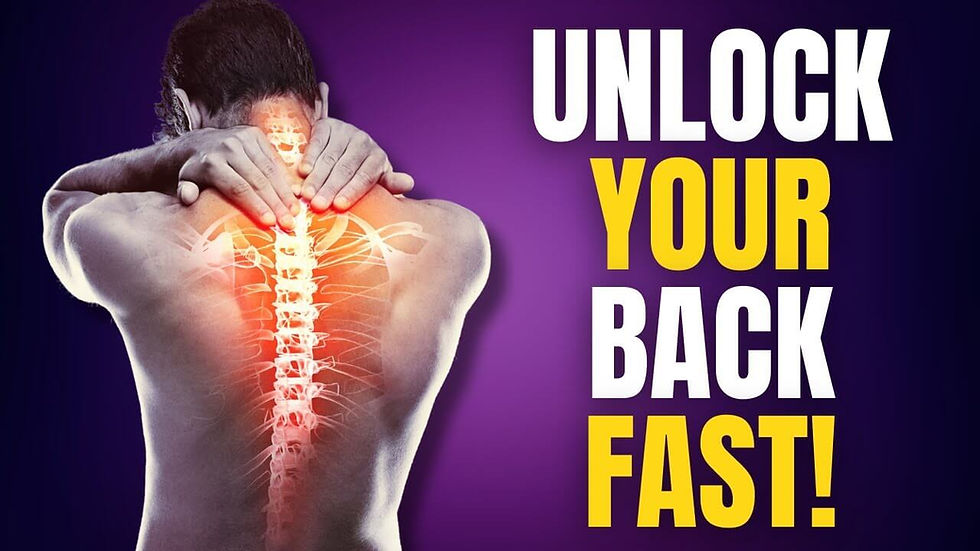
%20(1).jpg)


This article is a transcribed, edited summary of a video Bob and Brad recorded in April 2025. For the original video, watch https://youtu.be/h38BWUB_61k
Brad: All right, now, looking at the title, I know what some people are thinking. You cannot crack your back unless you have assistance from a chiropractor.
Mike: Well, we're going to show you five safe techniques you can actually do at home on your own, and we've done it with many people.
Brad: That's right. Plus we're going to actually tell you why your back gets tightened up, and gets those knotty feelings, and allows it to crack and feel better. The first question we're going to talk about is: why does your back get all knotted up to the point where you feel like you need to get it cracked to get that relief? So, Mike?
Mike: Now, we're specifically talking about the mid-back or thoracic spine region here.
Brad: Here, turn around. We'll show them. From here to here, that's the thoracic; this is the lumbar and the cervical. So we're talking right here, kind of around the shoulder blades.

Mike: So, this area is most commonly problematic because people are sitting down at their workstations with poor posture, they're driving their cars with poor posture, or they're staring at their phones or laptops in poor posture. So you're constantly rounding your spine in that thoracic area, putting a lot of tension on the muscles.

Brad: That's right, posture, posture, posture. So critical. So, should we carry on?
Mike: All right, so we're going to go through five different stretches or exercises you can try, but we just want to say a word of caution. If any of them create any type of pain, do not continue with that one. And if it keeps causing pain, you may want to see your doctor.
Brad: That's right. In other words, if you feel any pain at all, stop and go on to the next. But these are all exercises that we do on a daily basis. This is the first one I do. It's very simple, but it works for me. I lie on the ground like this, and I stretch up, and I stretch my hands up, and usually in the morning, the first thing I do, this will pop my back, and it feels good.
Brad: Another thing that I do lying on the floor is I take a six-inch foam roller. Now, these are variations of lying on the floor, so don't worry; how you count these for our five is up to you. But this one oftentimes works right in here, right about there. And it hasn't happened yet. I've already done this this morning. Oh, a little bit right there at about T-11, the lower thoracic area.
Brad: So I know, Mike, should I just show him what you like to do?
Mike: Yeah. I like to lie on the foam roller the other way. And what I actually do is something from our friend Rick Olderman, where I make snow angels on the floor. Now, if you are really tight and can't get your hands to touch the ground, kind of like Brad is, then you may not want to do the foam roller and just do this on the ground. But I like to do this, and it feels really good every morning.
Brad: Right, the other big benefit from doing all of these on the floor like this is it helps your posture as well, as it gives you the potential to crack your back. You can use a soft ball like this. There's a lot of little options we're going through, and rolling feels great. Oh yes, this is good. Mike just brought this ball in today.
Mike: Yeah, it's a bender ball. I did a podcast with the lady on core strength, but it's a fun little ball.
Brad: A softball; this will be aggressive. It will work the muscle knots out as well as crack your back. But be careful: if you do this one, if you've never done it before, it'll probably be a little uncomfortable. So, just be careful. If it's not comfortable, simply stop. Alright, off the floor.
Mike: Those are options one and two. You should stay on the floor, because you're going to show the pretzel stretch next.
Brad: Oh yes.
Mike: So option number three. Most people know this. I've heard it called many different things. We're going to call it a pretzel today.
Brad: There you go. So this one I learned when I was in karate about 40 years ago, 30 years ago. And every time I did this stretch, it always felt good, and it almost always cracked my mid-back. And I would go like this: gently rotate, look behind you, like you're backing your car up without the rear-view video. And again, no pain should be experienced. If you experience pain, do not do it. Do it both ways. It's a nice range of motion. Stretch gently. It never takes a lot of stress or pressure. Again, these are all gentle, easy things to do.
Mike: I like to sit in this position for like 15, 30 seconds, take a big inhale, and then when you exhale, turn a little more, and you get more of a stretch. Just kind of a nice, ooh, I really feel that.
Brad: There you go.
Mike: I feel it in my glutes, not even my back. But shall we go on to the next one?
Brad: Right. There's one thing I want to mention. If you're older, or even younger, and you happen to have osteoporosis, weakness of the bones, then I would just not do any of these, actually.
Mike: Yeah, you can check out Sara Meeks. She's an osteoporosis expert. Anyway, the next one we're going to work on is actually hanging from some sort of pull-up bar, or hanging handles, whatever you have available. So typically, people are kind of bent over; sometimes just trying to get into this extension can really stretch that out. So, when you're doing this, just grab on, and then bend your knees a little bit, and make sure it feels good on your back. Obviously, if you're on a pull-up bar in a gym, you're not going to have the wall for support. But if you have the hanging handles, you do, and it's kind of nice.
Brad: Yeah, that really is nice. It gives you more control, and it also improves your posture because it kind of forces you. You can have your head touch your shoulders, and your belt line area touch, which gives you perfect posture.
Mike: So what you can do is just kind of hang for 15- 30 seconds if that's tolerable. Notice my feet are touching the whole time. I'm not being too aggressive. If you're younger and stronger, and you can hold yourself up, it's fine to hang with your body weight, but you're going to get much more of an aggressive stretch.
Brad: Right, and if it does irritate your shoulders and creates pain at that location, you do not want to do that as well. Unless you see one of our shoulder videos for hanging, that's a little bit of a different story. All right, we got one more, don't we?
Mike: We do.
Brad: Mike, you're the star on this one. This is a stretch that Mike started about 10 years ago or more, in the clinic working with patients. And it worked out so well that we just continued, and we call it the patented Mike Back Thoracic Extension Stretch. The patent number hasn't come through yet.
Mike: I think other people have done it before me. But anyway, so what you can do in a chair is just simply work on extension. So if you're in a forward posture, maybe first, you just want to work on getting into extension, then you can try bringing your hands back.
Mike: But notice that the chair is going to limit how much spinal extension you actually get, so you can just place a small ball of sorts, kickball, bender ball, whatever you got available, and do the same thing, and you're going to get into more extension. Ooh, I can feel that.
Brad: There you go.
Mike: And you can mess around with what position you want to place the ball. You can have it lower, higher, kind of depending on where you're feeling that back discomfort.
Brad: That's right, so when you said you could feel it, you mean it was uncomfortable?
Mike: No, it's good. It's a good stretch.
Brad: There you go. And notice he's rolling back and forth. All these things that sometimes we don't think about, we should bring out. If you have a chair, make sure it's a firm chair, and it helps if the chair level at the top is about shoulder blade level, not that it comes up here, because it gets in the way when you go backwards.
Mike: It does feel nice just to hang out like that.
Brad: It does. Yeah. These are wonderful stretches even if you don't get your back to cavitate or crack; they're all excellent postural muscles and will unknot those tight knots from poor posture. Wow. And now we're babbling.
Mike: We are.
Brad: I babble.
Mike: If you want to check out more videos on how to fix your posture, watch "BIG 3! Perfect Posture Stretches-Anywhere & Any Age."
Brad: There you go. We don't know what it is because I forgot to put it on there.
Mike: Sure. It's a video from the picture earlier.
Brad: Oh, that's right.
Mike: I'm going to keep playing with this for a while.
Brad: Yep.
Medical Disclaimer: All information, content, and material on this website are for informational purposes only and are not intended to serve as a substitute for the consultation, diagnosis, and/or medical treatment of a qualified physician or healthcare provider.
Affiliate Disclaimer: Keep in mind that we may receive commissions when you click our links and make purchases. However, this does not impact our reviews and comparisons. We are highly selective in our products and try our best to keep things fair and balanced to help you make the best choice for you.