


.webp)


This article is a transcribed, edited summary of a video Bob and Brad recorded in April 2025. For the original video, watch 5 Hip Pain Tips (No Meds No Workout)
Brad: Oh, Mike, Mike, Mike. The hip, hip pain, I'd like to get rid of this hip pain, and we're going to show you how you can get rid of your hip pain as well without meds or exercises.
Mike: We're going to show you five easy ways to help reduce that pain from our experience working with patients for over a combined 60 years, because I'm not that old yet.
Brad: No, but you're getting there, and you will get there. So anyways, now this is a very special video. We're going to go back in the archive; we picked up a video from years ago, about 10 years ago, and we're going to go back, show a little bit of that, and it all ties together to make this video reach all of our goals about hip pain so you can live without it. Mike, are you ready?
Mike: I'm ready; we're going to go time travel.
Brad: Okay, yeah, we're going around, Mike. You ready to go?
Mike: I'm ready to go.
Brad: Okay, come on, Mike, let's go. Woo woo woo.
Bob: Hi, I'm Bob Schrupp, physical therapist.
Mike: I'm 'Brad Heineck,' physical therapist.
Bob: It never gets old. Together, we are the most famous physical therapists on the internet.
Mike: Well, in our opinion.
Bob: Yeah. And you know, Brad's going to be back eventually- the real Brad; he's just taking care of some patients today. So for all you old women out there that miss Brad, now we got something for the young eyes, you know, so. All right, today we're going to talk about how to test whether or not your hip flexors are tight. This is kind of a cool test, Mike, because I think a lot of people don't know how to do this.
Mike: Yeah.
Bob: So, it's called the Thomas test, and I think it's also called the Thomas Stretch when you stretch it that way. So, Mike, why don't you get into position here? You need to basically go off the end of a table or end of a, you maybe could go off the edge of a bed.
Mike: It's a bit squishy.
Bob: Yeah, a little squishy. So we're testing whether or not the hip flexor is tight on the right side. So Mike's already doing it; he is pulling this leg up, and as he pulls this up, as you can see, this leg is actually raising up. Put it down, Mike. See how that goes down? Now pull it up. So that means that hip flexor is tight.
Bob: Now, the hip flexor actually crosses two joints; it crosses the hip joint, and it crosses the knee joint, one of the muscles, anyway, the rectus. So we're going to see whether or not it's the muscles that are crossing the hip joint, or the muscle that crosses the knee joint. So to tell whether or not it's the rectus, if I straighten the leg out and it goes down a little bit, which it does, right, Mike?
Mike: Mm-hmm.
Bob: That means that there is more tightness in the rectus femoris. I know this is a little complicated, but very simple: if he pulls up, and the knee is bent, and the hip goes up, he's got some tightness; we know that. Now, if I straighten the leg out and it goes down, then we know it's the rectus femoris where a lot of the tightness is.
Brad: Whoa, here we come back from the time. Thanks, Mike.
Mike: We made it.
Brad: That's actually the first time that Mike was actually seen in the time warp. And a little history of this young man: he has become the expert on how to stretch the hip to reduce pain. We'll get that at the end of the video just as a bonus. But first we're going to go into the five pain-free treatments for the hip. Now, the simple old method that has been very consistently helpful is a cold pack. Mike, do you want to lie down?
Mike: I suppose I can. A cold pack, or a hot pack.
Brad: Right. You know, if you have an injured hip and it's just recently, say you fell on it, or just started, and it's very tender. In other words, if you press on that area, ooh, it makes you jump; almost certainly you're going to need a cold pack. Now, I want to recommend a gel cold pack that you put in the freezer, and if it's a good one, when you pull it out, it is still flexible; it's not rigid. Okay, Mike, do you want to lie on your side with your sore hip up?
Mike: So we'll pretend my right hip's painful.
Brad: So the first thing you're going to do is put a pillow between your knees like this. The next thing is that cold pack; you're going to want to make sure you have cloth over it, you know, because Mike has a nice, this is about right for, you can use pants, or, you know, your pajamas or whatever. Put that on there for 15 to 20 minutes; let that cool down. You can go a little longer. You really can't go too long with a cold pack, because it simply warms up, and it's no longer a cold pack; it's a lukewarm pack. So that can oftentimes be a big help.

Brad: Now, some people, if you have a nagging hip pain that's been going on for a while and it feels tight, that's when you may want to use a hot pack. If it's really tender, you don't want it, but if it's tight and it's a nagging pain, you can use a hot pack. Now, this hot pack is weighted, much superior in my experience, because the weight allows the pressure and the contact to go over the hip; it's very comfortable, warms up well, and that's going to be a nice way. You're going to leave that on for 15 to 20 minutes as well.

Brad: Now, if you want to go the next step further and you want to get the heat really deep, the only way you're going to get deep heat that you can easily do at home is through a far infrared hot pack. It's definitely different, and as opposed to going skin deep, this is going to go 2.36 inches, according to studies that have actually been done. And you're going to use that over the top.
Brad: Now you can put this in a chair, say a recliner, and if you're sitting in
the recliner, you'll put it over your waist or over your hip. I like to take a pillow, and the armrest will be here, and I'll put the pillow in there to help make sure there's some close contact to the body with that. Again, this will go much deeper. The disadvantage of them is they do cost quite a bit more, but you can use this also for other parts of the body. That's the Thermotex Platinum model; they're very popular. They've been around for, I think, 28 years; it's been a long time, they're tried and true, and they're a good product. So Mike, do you have anything to say? I'm done talking.
Mike: Now, the reason we want a pillow between our knees for hip pain is that it keeps your hip in a nice neutral position. If I take the pillow out, it's more of a downward position, especially if you're having lateral hip pain, this is going to put more strain on it, and oftentimes laying on that side can be painful as well, so keeping it up like this with the pillow in between can be very beneficial, for that reason, plus, it keeps you from rolling too much over. But the next tip we want to talk about is actually using a leg wedge.
Brad: Yes, so, lying on your back, on your bed, you could do this, you know, on a carpeted floor, but go onto your bed and be comfortable. If you don't have, you could just simply use, probably two pillows are going to work better than one, put it here, and that elevates, flexes the hip slightly; it takes pressure off it. Oftentimes this can reduce your hip pain, as opposed to lying flat.

Mike: Yeah, I'm ready for bed already.
Brad: There you go, a notable percent. Now if this feels good, can you lift your legs up? Use a leg wedge; this'll oftentimes work better. I don't know if I've ever had anybody say the pillows feel good; this always feels better. You certainly don't need to purchase one. They're not that expensive; buy them online. Don't get it confused with the triangle wedge.
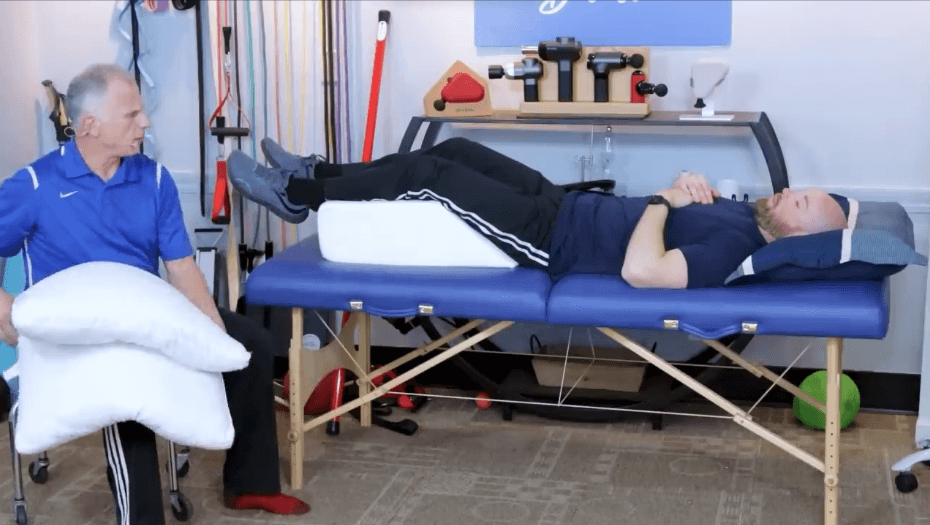
Mike: Just look for 'leg wedge.'
Brad: Yeah, leg wedge, very important. So that can be really helpful. And you can use a cold pack or hot pack on the hip while you're in this position as well. We use these tricks together, and they can be very beneficial.
Mike: Now, the next tip is actually something called traction. Brad will show how it would work in a therapy world, but you can also do this on your own at home, simply using a step and a cuff weight or boot.
Brad: All right. Now, we have made a video where, you know, if you have a family member or friend at home while you're in bed and you trust them.
Mike: I don't know how they trust you.
Brad: Well, yeah, be careful. Just simply grab the ankle and traction; I'm pulling this way. Now, if your hip hurts, and you do a little traction like this, as soon as the traction is applied, it says, "Oh, that feels good," then you would continue. You're not pulling as hard as you can by any means; a gentle pull. Sometimes if you go out to the side, it might feel better. Again, the only reason you're going to do traction and work with it is if it immediately feels good as a result of it; maybe hold it for 30 seconds or so, that's it. But don't get aggressive with it, just a gentle traction.
Brad: You can do this all by yourself: go to a step; I'll demonstrate here.
Mike: I'll just keep napping.
Brad: Yep, you take a nap, Mike. Here, play with that.
Mike: Have you got an eye mask for me? I'll take an eye massager, please.
Brad: What you'll do is stand here like this on a step, or any kind of portable step. This is a sore leg; let the weight of the leg be completely relaxed, and you can kind of give it a little movement if you want. But I've had people with hip pain, particularly labral tears, where they do this, and it just feels good to distract the joint and allow it to move without weight-bearing. You could put a boot on or a cuff like this around the ankle, which increases the distraction a little bit.
Brad: Again, if you don't have one of these, you live in the northern part of the world, or you have a steel-toe boot, a couple of pounds of footwear will work the same way as a weight. You're going to do this for 30 seconds to a minute. There you go. And then after that, it should feel better. If you do this and it hurts afterwards, which is very unusual, but if it does, then you would not do that option.
Mike: Now, another tip, tip number four, is to actually massage the muscles around the hip. Because if you are having pain, oftentimes the muscles can contract or get tighter on you, so stretching is good, but sometimes massaging is too. Now, you could certainly use your hands and massage in there; that's fine. Any type of massage tools you may have, or even foam rolling if you're comfortable getting on the floor to do that, are all viable options. However, most people find that if you have a massage gun, it's a pretty easy way to massage your hip; you can just work the different areas connected to your hip. So you're going to work your quads, your hip flexors, which are in the front of your hip. You can work the lateral aspect, which is your IT band region. You just want to be careful of any really bony areas, not to use a really firm massage head, maybe use a cushioned one, like the ball, or even an airhead one is an option. You also can work into the glute max region, or your buttock, and into the hamstrings, because all these muscles play into, ooh, my hamstrings, all these muscles play into your hip.
Brad: And I always massage my hip in this fashion: I lie on my side, bring my knee forward, I may put a pillow under here, and then you can get on the backside of your hip really comfortably, and it works.
Brad: So I'm using the hot-cold head on the C2, I've got it, ooh, it's on the warm, yeah, on the high level warm, working at... Again, if you have a hard head, you don't want to get over your greater trochanter, that bony part; that's when you're going to want to use the round head, as I have on this Q2 massage gun, and then you can more easily, or the soft air head works really well, and, you know, really good, you can do the whole hip.
Mike: You're getting in the piriformis region there too.
Brad: Yep, piriformis.
Mike: You can mess with- I like to kind of mess with the area or stretch I'm doing with it, like Brad is going that way. Sometimes if I'm working the piriformis, I might lie on my back, and I might go this way if I'm seated even, and just mess with the angle where you feel tightness.
Brad: Yeah, good.
Mike: Yeah, it's just a good way you can massage; you can use any massage gun; these are just the Q2 and C2 Pro models. What's our last tip, tip number five?
Brad: This is one that I personally experienced. I was having severe hip pain, and it actually was very uncomfortable to walk; I was limping. It happened on a Wednesday; by Saturday I couldn't walk unless I used crutches. So that's what I did: two crutches, and I just took the weight off. Or toe-touch weight-bearing; it might work with a cane where you, you know, 50% weight-bearing or so. The right is my sore hip; I use the cane in the opposite hand, and they work together.
Brad: Sometimes just a little bit, you know, 20%, 30% weight-bearing through the assistive device or the cane is enough to make the hip feel much better. Had that happen many times. Don't worry, the goal is not to use this forever, just until that hip pain subsides, and then you won't need it anymore.
Mike: If you're already using a cane and it's still problematic, maybe use a walker.
Brad: Yes, yep.
Mike: Because you can put more pressure through your arms. Crutches, you know, if you are able to use them and you feel comfortable, they're definitely fine; you can take all the weight off if you want.
Brad: And with crutches, you can actually do a little distraction and let it hang and swing.
Mike: Oh, there you go. And then you just put a massage gun feature right there on it, and then you can massage them better.
Brad: Oh, 2-in-1. That would be a MacGyver.
Mike: Walking sticks kind of depend, because you can't put as much weight through them, but if you have them, you can certainly try them out, I guess, as an option.
Brad: It offers stability so you don't lose your balance if the hip pain isn't that bad, but you feel unstable, and that will help you feel stable, and at least get you moving around without a fall risk.
Mike: But those are the five additional tips to try out and see if they all work. Again, no exercises needed. Now, if you want to check out a video where you can actually do some exercises or stretches, watch "3 Miracle Exercises For Hip Pain". But Brad, I think you have something to say.
Brad: Well, I do want to say, if your hip pain continues to get worse, like in my situation, I was limping, using crutches, and Monday morning I was going to go to the doctor. But it was one of those weird things; by Sunday I was feeling better; by Sunday night, no crutches, and it did resolve on its own, which does happen. But if it doesn't, you need to get in to see the doctor; you may need some X-rays and see if there's some problem- maybe you had fallen on it, or sometimes you just have an issue with a labrum tear possibly, or possibly even the capsule could be pinched in there. And that needs more attention than what you can do on your own. So once again, after all that, we can fix anything except for...
Mike: A broken heart.
Brad: That's right. Thanks for the time machine today, Mike. Be careful.
Medical Disclaimer: All information, content, and material on this website are for informational purposes only and are not intended to serve as a substitute for the consultation, diagnosis, and/or medical treatment of a qualified physician or healthcare provider.
Affiliate Disclaimer: Keep in mind that we may receive commissions when you click our links and make purchases. However, this does not impact our reviews and comparisons. We are highly selective in our products and try our best to keep things fair and balanced to help you make the best choice for you.


