.webp)


This article is a transcribed, edited summary of a video Bob and Brad recorded in January 2025. For the original video, go to https://youtu.be/PwVWxWQNcpY
Mike: If you've been doing a Superman exercise for back strength, it's time to stop.
Brad: Well, and we're going to actually explain why it's potentially dangerous as well as give you an option that is from the expert in the field, and we will tell you that in just a moment.
Mike: So, when we're talking about the Superman exercise, Dr. Stuart McGill, who is a back pain expert, does not recommend doing it. Brad, can you show what happens in the spine when we're doing this?
Brad: Let's talk about the Superman exercise and why people want to do it. It's to strengthen the back muscles, which they're really working hard going to town, and it's true, it's a good exercise for the muscles, but what happens if you look at the spine while you lie in a relaxed position, it's neutral. Now, go ahead and go up in the Superman and look what happens. The back or the spine arches.
Brad: So now we know that, but what's the problem with putting that in there when those muscles are at maximal contraction?
Mike: Well, we can start getting some back pain or some issues here. You're having a lot of compression and extension, especially if you have back pain already.
Brad: Right, and if you read Stuart McGill's works, he goes into detail about the studies on how much pressure actually goes into the spine at that location. We're not going to bore you with that, but you can look in his book. Now, what are the options, or what else can we do, or do we have some other stuff to cover, Mike?
Mike: So, first, we want to talk about some back pain tips here before we get into the strengthening exercises you want to do, especially if you're having back pain. So tip number one is to avoid over-sitting. Now, that just means sitting too much. Typically, you have the most amount of pressure on your spine in the seated position. You have less when you're standing because your legs are weight-bearing, and you have even less when you're lying down on your back flat because there's not as much gravity pulling down on your spine.
Brad: Particularly when you sit with poor posture, which, to be honest with you, many people do. It's just part of the deal.
Mike: So if you are stuck at a computer or you're on a long car ride, take frequent breaks and get out of a sitting position. It can help with your back pain. Tip number two goes exactly with this: stay active. Walking and movement throughout the day are actually beneficial for your spine.
Brad: That's right, whether you go for a dedicated walk or just get up in the office or at home and walk around every 20 minutes or so is much better than a consistent static seated position.
Mike: Tip number three is to maintain a neutral spine as often as you can. Neutral spine, we mean when you're standing with good posture or seated. We don't want to be too flexed over like this, which happens when you're looking at your phone or working on your computer, and you don't wanna be too extended like this either. I mean, I don't know any, I guess if you're doing overhead work, because who extends too much?
Neutral Spine Flexed Spine Extended Spine
Brad: You never do any work. But yeah, if you're washing the windows, working on the ceiling, whatever.
Mike: I don't do a lot of overhead work, no. And tip number four is just some gentle range of motion throughout your spine is actually beneficial. You just don't want to go to the extreme ends. So, something you can do is the cat-cow.
Brad: Some people call this the camel horse or something like that.
Mike: Cat-camel.
Brad: Yeah, that's it.
Mike: So you just get on all fours, and you just kind of, this is the cat position. It's like a cat that's mad. And then you go into the other position where your butt goes up, and your spine goes the opposite direction. Just go with what's pain-free, but this is some gentle motion you can do in your spine.
Brad: Can you show the neutral position? About right in the middle, so we get there versus extreme extension or rounding. All right.
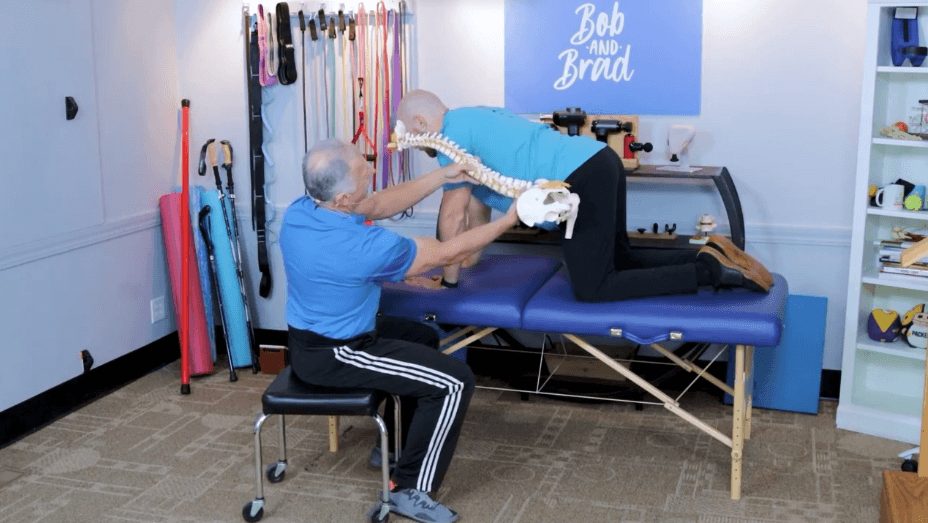
Mike: So that's one option, and another thing you can do is actually stretch out your hip flexor muscles because on some people they get so tight they actually cause your pelvis to turn, which affects your low back.
Brad: Right, hyperextends the lower back, tilts it forward, and it's no good.
Mike: So, just doing some hip flexor stretching can be beneficial. You think we should show one or? So you can lay off the edge of the mat or a firm table. This one is usually beneficial because people with back pain can get in these positions okay, and it won't hurt their back more. So if I get my butt back towards the edge, I have both knees to chest, I drop one down so I'm stretching my left side. Bend the knee and bring this one back up, and we're getting a hip flexor stretch here. Having a nice flat surface like this keeps my back in a good and safe position. So I'm in a neutral spine right now.
Brad: Yeah. Now, I'm going to say, and people might say, "Well, I'm at work, I can't get out on a table or bed and do this." I'll give an option that you can do while seated, so that it can be done throughout the day without interrupting. In your chair, you turn sideways so that one hip is, your buttock is actually off the chair. Best with an armrest and a firm chair. And let this go down. Simply stay up tall. And right there, I'm feeling a stretch, and I pull that knee back like this, and if I arch back a little bit more, we get a better stretch yet. Work on that a little bit, make both sides naturally, and do that every hour or so.
Mike: You can hold it for 15 or 30 seconds, and just kind of stretch them out. See if that helps. Now, on to Stuart McGill's big three. These are his recommendations for strengthening your core, which involves your abdominal muscles, your hip muscles, as well as your back muscles, and most of these are pretty safe for most people, and they won't exacerbate any back pain you may be having.
Brad: Yeah, these are nice exercises, very complete for the core.
Mike: So the first one's going to focus on the abdominals. It's called the McGill curl-up. So you're going to have to lie on something flat. If you can get on the floor, go to the floor. If you can't, you could do it on the bed. It's just going to be a little squishy. So normally we're going to have one knee bent and the other straight. In this position, we're going to do sort of a crunch, but in most crunches, we round the spine, we look up like this. This is flexing. It doesn't feel good if you have back pain. So instead, we're gonna bring our chin towards the ceiling and just lift our shoulder blades off the mat, and I'm not going to curl. Nice neutral position. Go up and then back down, and you just curl up a little bit, hold, back down. I'm feeling a workout here. It looks simple, but it does work if you go slowly.
Brad: This is what I do, I cross my arms across my chest, and I actually put one of my fists underneath my chin, which forces me so I can't look and flex my neck.
Mike: I feel like I'm punching myself. You could do it this way. Some people, if they feel good, you could put your hands behind your back. You can do all sorts of things. You can get the foot activated. But this is just a nice core-strengthening exercise that keeps your back in a good position.
Brad: All right, what about the side plank, so we get the side muscles of the core? This is a really nice one; most people do not do.
Mike: Yeah, so what you're going to do is like a plank, but the side plank, you're on your side. Typically, people hold this for 15 to 30 seconds. If you're strong and want to go longer, you certainly can. So what you want to do is stack your feet on top of each other, lift your pelvis off the ground, and try to keep it in a neutral position. A lot of people, if they're weak, they sag like this. Nice neutral position, you're going to hold this.
Brad: I think you're a little bit high, go down a half. Perfect, right there.
Mike: You're going to hold this for 15 to 30 seconds, and don't let anyone hit you with a stick. And then you're going to switch sides and do it on the other one like this. You're going to feel a lot of strengthening in your lateral side muscles here and in your lateral leg. If you're too weak to do this, you could start on your knees and just lift up like that.
Brad: There you go, yeah, this would be the beginner. This is the way I do it. What about the bird dog? This is one of my favorites.
Mike: The bird dog surprisingly works your balance a lot because we've had some people in the clinic we've tried this with, and sometimes they get a little tippy on it.
Brad: Yeah, so it's a win-win situation. Core strength plus balance.
Mike: So, for beginners, you go on all fours like this. If you can't get on your hands and knees, you can do this standing next to a wall. So what you're gonna do for beginners is just try to lift one arm up and then the opposite leg out. So what you want to do for the full exercise is opposite limbs going up at the same time. You hold it and then back down, and then you switch sides, and you do roughly 10 on each side. Now, it's hard to tell what your leg is doing behind you 'cause you cannot see it, so a lot of people go way up high. You don't have to go that high. Just kind of go to a neutral position. You can film yourself or have someone yell at you if you're doing it wrong, as Brad would.
Brad: Well, I wouldn't yell, I would talk politely, but one thing we really want to think about is before you start, get your back in a neutral position and be aware of that, tighten up your stomach muscles, and then do the exercise so the core really stays solid.
Mike: Make sure you're going opposite because you try to do the same side, and keeping a neutral pelvis is pretty hard because I'm cheating now. So go opposite.
Brad: Did you talk about whether this is too difficult because it will be too difficult for some people?
Mike: Then yeah, so what I said before, just do one at a time, one arm, then one leg. That way, you don't have to balance as much.
Brad: Yeah, and again, remember for other people who don't feel comfortable with that, against the wall is really a nice option, and it still works the right muscles.
Mike: So those are the McGill big three. If you do want some strengthening for your core and back exercises that won't exacerbate any pain, I would stick to those and eventually build up the duration or reps with each of them. If you're still having some back pain and you think it's sciatica, where the pain actually goes down your buttock and your leg, you can watch the video "Only 1 In 5000 Know This About Treating Sciatica."
Brad: Thank you.
Medical Disclaimer: All information, content, and material on this website are for informational purposes only and are not intended to serve as a substitute for the consultation, diagnosis, and/or medical treatment of a qualified physician or healthcare provider.
Affiliate Disclaimer: Keep in mind that we may receive commissions when you click our links and make purchases. However, this does not impact our reviews and comparisons. We are highly selective in our products and try our best to keep things fair and balanced to help you make the best choice for you.