.webp)


This article is a transcribed, edited summary of a video Bob and Brad recorded in February 2025. For the original video, go to https://youtu.be/zxiXdXDjlj8
Mike: Ever feel that sharp nagging pain that radiates down your back and goes into your leg?
Brad: Or maybe it actually is that dull ache that really starts to irritate when you sit for a long time. Even sometimes walking or lying down, you get that ache. It just never goes away.
Mike: Well, that condition is called sciatica, and it's actually irritating, one of the longest nerves in your leg.
Brad: Right, the sciatic nerve. And we actually have a simple stretch, and it's going to help you get rid of it. So we have the spine here today to give us a little more authority.
Mike: This is Spiny. Anyway, what we want to talk about first is sciatica itself. And typically, how does that originate, Brad?
Brad: Well, we're looking, it actually comes from the lower back. You can see that this red area here actually represents a disc that's actually herniated or bulged right here. You can see that the healthy discs above and below it do not look like that. That bulge actually impinges on one of the peripheral nerves, and that nerve goes down, becomes part of the sciatic nerve, and causes that pain, numbness, tingling, all these very irritating, painful sensations going down the leg, even to the toes.

Mike: So next, we want to actually get into what causes these discs to weaken and herniate like that.
Brad: We're going to go over three major problems that create disc problems. Number one is the big one, posture, particularly in a seated position. Now, if I'm sitting here tall like this with good posture, I'm okay. But so many of us so much of the time end up slouching and rounding our backs. You can see I'm slouched here if you look at the spine. And we look here, it actually stresses that area where the disc is bulging, can make it worse, and really causes severe herniation, making it uncomfortable to get up and move around after this posture is sustained, Mike?
Mike: Now, this doesn't take a day to happen. This often is from bad habits over the years. That's why most people start developing sciatica later on in life. It's all these eight hours a day at work in this posture that can start wreaking havoc on your low back, so it's important to look at that. Now, the second part we want to talk about is flexion of the spine, like we talked about, bending over with compression. Now, what that means is either you're bearing weight through your back if you're, say, doing an exercise of sorts, or if you're just picking something up. So if I'm going to go pick up something heavy off the floor, if I have bad posture, I'm already having strain on my disc. Now, if I add weight and resistance to it, you've seen those people go like this, and then they're in pain.
Mike: So this is also adding a lot of compression to your spine. I'm not saying you should never pick up anything off the floor, just be, have proper hinging mechanics when you're doing something. Picking it up the right way takes a lot of stress off your back. But something to be aware of.
Brad: And finally, this is a big one, when you actually combine picking up with poor body mechanics, rounded like Mike is going to demonstrate, and then actually throwing the weight or moving the weight to the side when you rotate. How are you doing there?
Mike: I'm okay. I have a pretty sturdy back yet.
Brad: Right. So if we look at the spine, we're putting stress on it and that flexion, which irritates it, and then twist and rotate it.
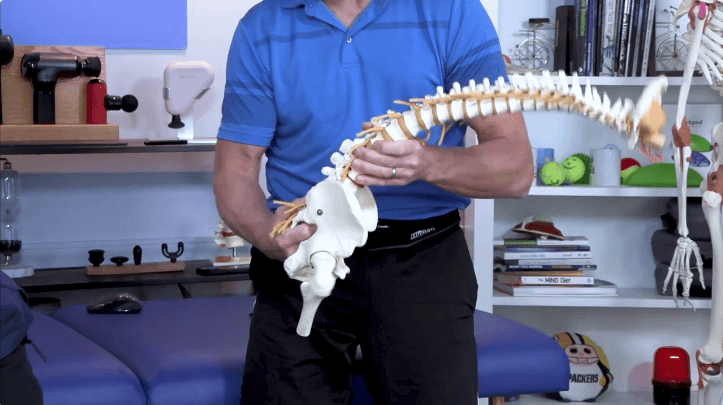
Brad: I mean, it's a hard time even to do that with the model of the spine, which is actually quite accurate with the spine. So that's a big one. No bending and twisting with a load.
Mike: So anytime you're going to do any of these activities, just be aware of your posture and make sure the load you are moving is appropriate for you, not too heavy. Oftentimes, if you just have good mechanics, it can prevent these issues.
Brad: There you go, and if you do have it, now we're going to go over the solution on how you can do a simple stretch and a few different ways to do it so that a problem can be resolved. All right, now, in the days of old, it was really common to have decompression or traction. That takes a lot of effort. You need a machine, sometimes, to do it. And we found out through Rick Olderman, who's discovered this is kind of a traction, but it's one-sided. You don't need anything special. You could actually use a doorframe, which Mike is going to demonstrate the stretch to take the stress off of that nerve, relieving the pain. And I'm going to show another option using a stick.
Mike: Just so you can see my back more. I'll pretend I'm having pain and sciatica on my right side. So you're going to go to a doorway. If you happen to have a pull-up bar at a gym or at home, you can use a pull-up bar instead. That's perfectly fine. I'm going to reach my hand away from me on the same side of the doorframe. And then I'm slowly going to lean into it, and I'm going to bend my knees. And this is actually where we're going to get that traction or decompression of the spine.
Mike: This will help take pressure off the disc herniation you may be having. Now this isn't going to fix everything long-term, but if you're having an episode of intense pain, it can really help with that.
Brad: That's right, now, if the door method isn't going to work because you're too short or too tall or some nature like that, you can simply use a Booyah Stik, a piece of doweling, PVC pipe, and you can put it on a countertop or chair. Mike, can you take your shoe off, please?
Mike: I don't know many people who ask me for my shoes, but okay.
Brad: There you go, put the stick in the shoe, and that'll keep it from slipping, which is critical. Now remember that pinch, that bulging disc is on the right side, pain going down the right leg. So we're going to actually open that up by doing the same thing Mike did, but holding onto the stick nice and tight up high so the hand does not slide down. Face palms away from me. And I'm just going to lean into it. And you can see right here, things are stretching out, opening that gap, taking the pressure off of that nerve being pinched and holding it. And then you can come back up and just rock it like that.
Brad: You're going to have to work it a little bit to see which way really relieves that stress and that pain as much as you can. There you go. That feels good. All right.
Mike: How's my stinky shoe?
Brad: Ah, yeah, that's enough of that. Anyways, yeah, so you can also do it in a seated position, although standing is probably going to be best. But if you do it in a seated position, I'm going to do just like this and stretch it out like this. And every time I lean, I can feel the same stretch as I did when I was standing.
Brad: So it's a nice, simple stretch that can release that pain and get you back into the walking, normal pain-free life that you want.
Mike: Now, as for time, duration with this stretch, just do what feels good and what you can tolerate. Maybe it's 10 seconds, maybe it's 30 seconds, and you can do this numerous times a day. You don't just have to do it once. Maybe every time you go through the doorway, just do a little stretching. It could really help get those muscles elongated again, decompress that spine. But we realize most people want more exercise options for sciatica, so we have another video on the topic.
Brad: Yeah, the title is, "Only One in 5,000 Know This About Treating Sciatica."
Mike: Glad my shoe's back on, it doesn't stink now.
Brad: Oh, Mike, Mike, Mike. Okay, good luck with your sciatica.
Mike: Okay, bye.