%20(1).jpg)


This article is a transcribed, edited summary of a video Bob and Brad recorded in November 2024. For the original video, go to https://youtu.be/Nw4dAqLzm6A
Brad: Oh, tight, frozen shoulder. This is going to help you out, whether it's a frozen shoulder, whether it's arthritis, or after surgery or injury.
Mike: We're going to show you the best ways to help unlock your shoulder and get it moving normally again.
Brad: So this comes in two different parts. In the first part, we're going to show you specific stretches, and in the second part, we're going to show you two specific methods on how to accelerate the stretching, so you can reach your goals of range of motion the way you want it, faster. So, how are we going to get these frozen shoulders or tight shoulders loosened up?
Mike: Well, we have numerous options here, and the first thing we're going to talk about is how to stretch them out. Obviously, depending upon where you start is going to limit you with some of these, but just do what you can.
Brad: That's right. Should we go to the first one?
Mike: Let's go to the first.
Brad: Now, we'll do a little therapy lingo. We're talking about flexion. With the shoulder, it means how far you go forward.
Brad: Typically, that's one of the first range of motion or the planes that you address as a therapist. So what we're going to do is simply take a stick, a dowel stick, a Booyah Stik. You can use a mop like this, then afterwards, you can clean the floor. So, what you'll do, I'll demonstrate in the standing position, you put the stick on a countertop, a tabletop, anything of that nature. If it's slipping around because you don't have a rubber tip, take your shoe off.
Mike: If it doesn't smell.
Brad: Yes, and it should be a rubber sole tennis shoe, running shoe works great. Put that in there. Will solve that problem. And Mike's going to do the same thing, but he's doing it with the mop in the seated position. This hand will go up as far as you can. Now it may only go up a little way. What I recommend you do is take a Sharpie or a piece of tape and mark where you start, and you simply lean forward, keeping the arm in the same position, and look at what's going on with my shoulder. What's it doing, Mike?
Mike: You're getting a nice stretch. You're actually going into more flexion.
Brad: There you go.
Mike: In the way, and you're stretching out the shoulder joint, the ligaments, tendons, and rotator cuff muscles, allowing it to possibly move a little more freely.
Brad: Right, so you're going to ask, well, how long do I do it? Or how many reps? Five to 10 reps if you're going pressure on, pressure off, that type of cadence. Or if you want to hold it 15, up to 30 seconds, if you can allow that without creating a lot of pain. Now, what you'll do is you're going to, day by day, or it might take longer, sometimes frozen shoulders can really last a long time, this should help accelerate the whole process. You'll bring your hand up, and you'll see where you started, and it makes you feel better when you know you're making progress, just like that. Now, another way you can use the stick is abduction, and that's when you reach out to the side. Mike, do you want to show how that can be done?
Mike: You can do this a couple of ways. Are we going to do it seated or standing?
Brad: Well, we'll show them both. You can do seated, I'll show standing. I'll jump in when I get my shoe on.
Mike: So again, you can do the same concept we just did, but instead of going forward, you're going to go out to the side. So I put it out to my side, and then I lean into it, and you get a nice distraction force. Same concept as forward. If this isn't working for you or seems challenging, you can also just grab a stick, say this is my bad hand, and push it out to the side with the good hand and the stick. Both are fine. Pushing the arm with the stick is more of a motion, pushing it to a higher distance up. Leaning to the side, holding the stick, you're going to get more of a stretch in your shoulder joint.
Brad: Now, another nice thing is if you're doing this standing, and you could do the leaning, and/or simply just squat and get the stretch that way. Again, starting out low, going up higher, do the same thing, and get your mark, so you can progress or observe your progression.
Mike: Now, the next one we want to talk about is shoulder extension, which means bringing your arm back behind you. Typically, this one is pretty easy for most people, even with a shoulder injury. This is one of the first motions that come back. So what I'm going to do if I'm working my right arm is use the cane or mop handles I have, and push back as far as you comfortably can. Don't bend over to get more height. That's not doing anything for your shoulder. Nice posture. Push back. You can feel a stretch. Hold it five, 10 seconds. Again, you can do five to 10 repetitions of these.
Brad: Right, it's just like paddling a canoe. That's what I call it. I use this, I do this one for maintenance on my shoulder three days a week. The other way you can do this is put a stick behind you like this, not to the side, but directly behind you, and then you simply bend your knees, and that's a really nice way to get good extension.
Brad: As I mentioned before, you're going to emphasize flexion. So if you spend two or three minutes with flexion, you may only go abduction or extension for half that time or maybe even a third. You'll probably find that abduction may create more pain. If you're getting into sharp pain with these, it's too aggressive. Do not go into sharp pain. Mike, could you repeat that?
Mike: Do not go into sharp pain.
Brad: There you go. It's important that you don't overdo it and actually tear some tissues.
Mike: So the last motion we want to look at is the rotation of the shoulder. So you can go internal and external. Typically, internal with most people is fine or not that hard to get back. External is where we struggle. There are lots of ways you can do this. Now, you can go on a corner of a wall, you can do a door frame itself, or Brad'll show with a stick option. For beginners, just simply put your arm on the corner here and then slowly walk forward. This is going to slowly externally rotate my shoulder. Just bump into the pain a little bit, don't make it worse, and stretch it there. If this feels easy for you, you can certainly progress to having your arm up again on the corner and then walking out like this. Don't rotate in because this isn't doing anything. You want to make sure to rotate and step into it. Again, hold it for some seconds like this.
Brad: And if you're using a stick, elbows glued to the ribs. We're not winging out, glued to the ribs, and simply rotate like this, pressure on, pressure off, or hold it 15 to 30 seconds.
Brad: Now, if you're interested, and I'm sure you are interested in accelerating the process, we are going to show some tricks that you can do so that the stretching, the range of motion, is going to be gained as fast as possible.
Mike: But before that, I'd like to mention you can do it in the doorframe as well.
Brad: Oh, sure. In the doorframe, yeah.
Mike: Same concept. You just put it here if you don't have a nice corner available in your house. And rotate. You can also lean forward. I'm running into the steps, so I can't lean very far forward, but the same exact ideas.
Brad: All right, so we are going to show you two, really, the ways that therapists go about accelerating the progress for the range of motion. Cut. All right, the first little pearl to help your muscles stretch and get that range of motion you need is heat. You need to heat up the tissues, increase the circulation, allow the muscles to relax, and then when you get that, the stretch will become much more effective. So what do we have? The most effective heating pad there is, if you want to get the maximum depth of the heat. What is it, Mike?
Brad: So this is a Far Infrared Heating Pad. This is the Thermotex Platinum model. They have many variations and models. But with Far Infrared, it goes a lot deeper into the muscle and through the skin, which you actually want to warm up those rotator cuff muscles in your shoulder. Brad, how far does this penetrate?

Brad: Well, if you look at this yardstick, you can see the depth of this blue part. 2.36 inches is what the science has shown the depth of the heat goes to with this.
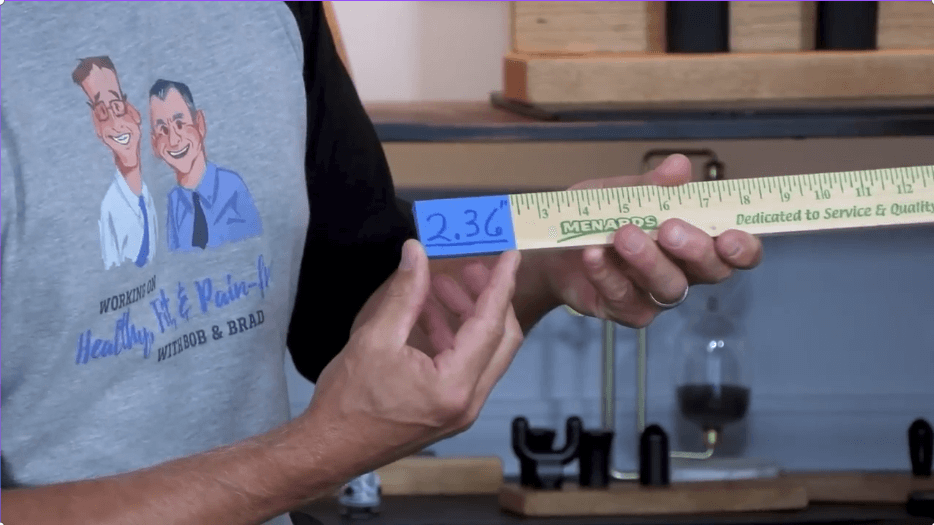
Brad: If you use a regular heating pad, you can, you don't have to purchase one of these, but you will not get near the depth. You'll only get about a quarter of an inch at the most. So this is the best, and that's what we're going to talk about. But again, you can use a standard heating pad.
Mike: Now, if you are using this one, we'd recommend that you be in a sitting position. That way, it can stay in place better. It does come with some straps, but just find a comfortable position. You can turn it on, and it only runs very cost-effectively. Pennies a day to operate this thing.
Brad: It does, it only has one setting, and that's just the nature of Far Infrared, if it's a true Far Infrared heating pad. And you have to put it on with the panels facing towards the shoulder. This one works best if you sit in a recliner. And if your muscles feel tight in the front, you'll focus on the front. If it's on the back, you'll put it on the back, and you can do it however.

Brad: Once you work with it, you understand where it goes. The only difference is that to get that kind of depth of heat, it does take a little more time. You will have that on for a period of 30 to 45 minutes, but you get the depth. So you're going to heat it up for either 30 to 45 minutes with Far Infrared to get into the capsule, which, with a frozen. If we have a regular heating pad, typically 20 minutes is what is recommended.
Mike: Obviously, if you have a microwave type one, be cautious that it's not too hot. Make sure to use some towel layers in there. Typical ones, yeah, just plug them in. They typically turn off after 20 minutes.
Brad: Right? And so you can leave them on longer. They just won't go near as deep as this. Now, after you've heated the tissues up, you go to these. There's one more step, and that is to go ahead and talk about these a little bit, Mike. I'm going to look at this one.
Mike: So, massaging the muscles around your shoulder joint. Now, you can work the muscles directly if they're not too painful or sensitive. You can also work on your pecs or your lat muscles, because they all kind of connect to the shoulder itself. So obviously, if you know someone who's good at giving a massage, they can do a massage on you, but if you're doing it yourself, it's kind of hard to massage your own shoulder, so a massage gun can come in handy.
Brad: Right, so make sure you get a massage gun. A lot of people have them; they're very popular, but the travel or the amplitude hopefully is around 6 to 10 millimeters, which is good. Typically, you'll feel a tight muscle if it's in the pec region or in the front. This is our C2 Pro Massage Gun. This one actually comes with a heated head, or you can put it on cool. So in this case, you'd probably put it on heat, and right now it's heating, and you're gonna work in. If you are a stronger, larger person, you'll want a bigger gun like this. You don't have to have it. But if you're a smaller person, a bigger gun's not so good. A gun, more like what Mike has there.
Mike: Yeah, the Q2 Massage Gun here is nice, small, easy to hold onto, and massage away with. I actually use one of these at home. It works just fine. I probably wouldn't use a really big massage gun on my shoulder joint specifically, but that's just me. If you are a very muscle-bound or a larger person, then an X6 Massage Gun might work.
Brad: That's right. If you do not have a hot/cold head, which a lot of people don't because they are new on the market, it's simply a round head like Mike has, or the airhead is what I would recommend. Most guns do come with that, most of the better guns anyway. And again, heat the muscles up. Work the massage for about three to five minutes in the area that needs it. One big precaution. Do not get into the armpit because you're going to hit your brachial plexus, which is the nerve bundle that feeds all of your arm for sensation and muscle control. If you irritate that nerve bundle, the brachial plexus, it's going to be uncomfortable. It can cause problems. So be cautious of that. Not in the armpit. On the muscles here, up here in the lats. And if you go to the backside, you'll probably have to have someone assist with the gun.
Mike: With the shoulder joint, there are a lot of bony areas in there as well, so you probably want to avoid any massage heads that are very pointy, like the bullet head. That's more for a trigger point in a larger muscle group, so.
Brad: Right. Yeah, so you know the nice thing about a massage gun, you can use it on a tight, frozen shoulder just as we mentioned, but you can use it on many parts of the body, the calves, like hamstrings, and quadriceps. Where do you use yours mostly, Mike?
Mike: I use mine on my legs a lot because that's typically where I'm tight, and I have most of my problems.
Brad: I have SI problems, SI joint, and I really find the airhead working that really helps put that back into place. You will use it, and they're just a wonderful thing. I really enjoy using it on my feet just for a massage.
Mike: Just don't call me an airhead. Anyway, if you want to check out more videos on shoulder issues, say you do have frozen shoulder specifically, you can watch "60 Second Frozen Shoulder Exercises & Stretches-Adhesive Capsulitis."
Brad: That's right. Help each other out. Take care and be careful.
Medical Disclaimer: All information, content, and material on this website are for informational purposes only and are not intended to serve as a substitute for the consultation, diagnosis, and/or medical treatment of a qualified physician or healthcare provider.
Affiliate Disclaimer: Keep in mind that we may receive commissions when you click our links and make purchases. However, this does not impact our reviews and comparisons. We are highly selective in our products and try our best to keep things fair and balanced to help you make the best choice for you.