.webp)


This article is a transcribed, edited summary of a video Bob and Brad recorded in October 2024. For the original video, go to https://youtu.be/kVWyeS-vvII
Brad: Keeping strong legs is essential as we get older for a number of reasons. Number one, it's going to help with your balance, and also it's going to help with your mobility. Anything else, Mike?
Mike: But more importantly, it can help with your leg circulation. So doing leg exercises can help with both.
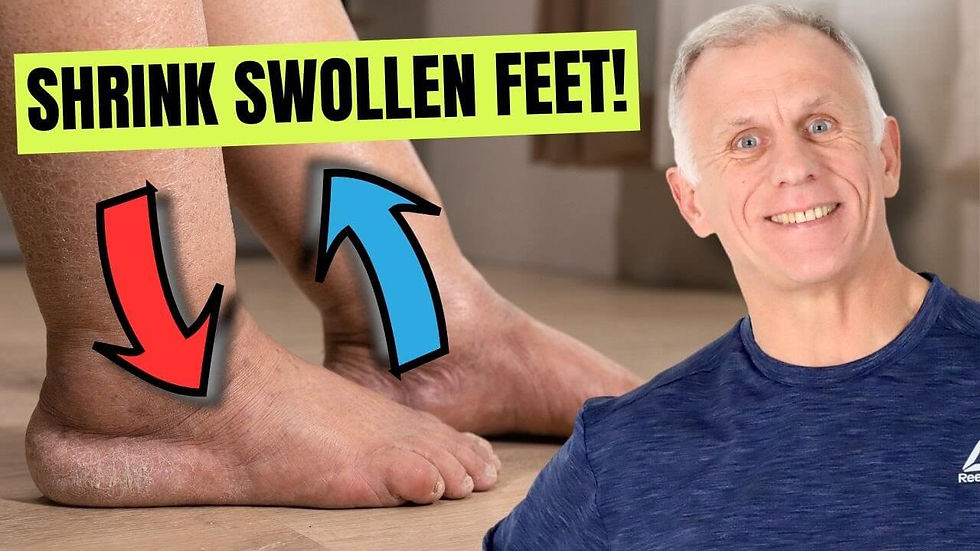
Brad: Getting that blood flow going and less swelling if you happen to have that particularly below the knees in your ankles.
Mike: So we're going to be starting out this video with what, Brad?
Brad: Well, we're going to start with body weight exercises, anybody can do it, modified to your level, whether you're a beginner or advanced. And then we also have some...
Mike: More advanced exercises at the end. You'll get the benefits of leg strengthening, circulation, and you're going to get some heart health benefits as well.
Brad: That's right. Full body, one of my favorite exercises, is going to be in there, and I'm really excited to talk about it. Okay, so we're going to demonstrate three exercises you can do in your home. Mike's going to start out. If you have some steps, this is a great basic exercise with great benefits.
Mike: So we're going to start with just doing some step-ups. So you're going to go with the right leg first, then the left leg. Now, if you have trouble with your balance or this is challenging, beginners, you can certainly hold on with the handrails here. And you can place your other foot on the step like this. This would be a beginner's way. If you like reps, do 10 on each side. If you like time, do it for 30 seconds.
Mike: If you're more advanced, feeling good, you can do a step up with a driving of the other leg, and that's a little more challenging, balance, and strength.
Brad: Yeah, I like that. You could go two steps at once, couldn't you?
Mike: Well, I guess you could just run upstairs if you want.
Brad: No, not like that. A double step. Show them the double step.
Mike: Oh, I see. You want a higher step.
Brad: There you go.
Mike: Yeah, if you want it really more challenging and you have the balance and coordination, just step up as high as you can get. Don't put your head on the ceiling, though.
Brad: Now, let's go to the traditional. Always go-to squat, excellent, functional, as well as the steps. And we're going to do it. Go ahead, Mike.
Mike: So if you are balanced and don't need to hold on to anything, just squat down to what you're comfortable with, back up. If you feel more challenged or like you're going to fall or have issues, you can do what Brad is going to show.
Brad: Have a chair behind you, a firm chair with armrests. And what we're going to do is just use the armrest if you need to be steady. Use your legs as much as possible, just until your bottom touches, and push up as much as you can again with your legs. You can go to one hand and then across like this or overhead. And we have the chair for a safety net to be safe.
Mike: If you feel all that is too easy, you can grab some type of loop band like this to hold on. If you happen to have a dumbbell and want to hold it out in front of you like this, the goblet squat is another way to add resistance.
Brad: What's a goblet?
Mike: It's a thing you drink out of, but not in this case.
Brad: Oh, that's the way they do them in Wisconsin. Anyway, let's carry on to lunges. I like lunges because they work your balance and really focus a little more intensely on your leg strength.
Mike: Now, if you happen to have sensitive knees, you don't like hitting the ground, you can place a pillow or a pad of sorts and do your lunges like this, just with one foot forward. It works. Do 10 on one side.
Brad: Here, use something for balance
Mike: 10 on the other side. The most important part is not to lean forward, bend down like this. I'm not doing a whole lot. We want to get some good stretching on the back leg as well.
Brad: There you go.
Mike: Now, if that's easy for you, you can do walking lunges where you actually walk around and do them. You can just do alternating lunges. So you can step forward with one leg, then step forward with the other. Again, you can hold onto a band or dumbbell for more of a challenge.
Brad: There you go. All right, so those are all body weight exercises, and we did give a couple of different options in regards to bands or the goblet thing that Mike was talking about.
Mike: Goblet squats. Make sure to do 10 to 20 repetitions with each of those to get that leg circulation pumping and build up that strength.
Brad: There you go. Now, shall we go on to the advanced exercises?
Mike: Yes. We have to go grab some stuff.
Brad: There you go. All right, so one of my favorite machines in regards to leg strength, as well as a full body workout, is a rowing machine. Now we've got this Teeter rowing machine that I like particularly, I'm going to go through some of the benefits that are really attractive to me and other people my age, I think. Mike, do you have anything to say?
Mike: This is actually called the Teeter Power10 Elliptical Rower, and it is a full-body workout. Fun fact, my mom actually bought one way before we even got this, and she uses it all the time. She's 65, has had a back surgery and hip replacement, and she loves this thing.
Brad: Great. Now, one thing that is really attractive to me is, I've used a lot of rowing machines, and most of them are about six inches off the ground. You have to get down to get on them. It's not a big deal if you're healthy and you haven't had any joint replacements, that type of thing. But this one, you simply go back and sit on it, then you get off, and it's very simple that way.
Brad: Let's go to other benefits that make a rowing machine, why it is so attractive to me: Leg strength. Now with this, it has stirrups. I call them stirrups. You lock in. Oops.
Mike: You unlocked them completely.
Brad: Yeah, don't worry about it. It's quite simple once you, there, we go. You can hear them slide in, and it locks your feet into the foot pan, so what you can do is you're pushing, working the quadriceps, more importantly, I think, is that you can pull back because your feet are there, and it works the opposite muscle groups, in other words, the hamstrings. It really is a nice option. And the resistance on this is a magnetic resistance. In other words, there's no mechanical parts touching, making it smoother, and it lasts much longer. A couple of other options or things I really like about this machine are that you can put your hands in multiple different positions, whatever's comfortable for your arms.
Brad: You can actually get it going, and right now my legs aren't doing anything, I'm doing all arm work, okay? And then you can put the arms down and just work your legs.
Brad: You can change the resistance. You can't maybe see it, but there's a knob right here, 7 different resistance settings from easy, and I'll go all the way up, oh!
Mike: Oh, you're stuck.
Brad: There we go. Get it going. I've got it on the highest one. But once you get it going and track your progress, there's a full digital readout.
Mike: There is a heart rate monitor.
Brad: There you go.
Mike: So if you want to check your heart rate while on the machine, simply strap that. You don't have to go underneath your shirt directly on your chest, and it'll give you your heart rate readout there.
Brad: There you go. Now I guarantee you this will work your full body as much as you can, now, one thing that people will ask who haven't worked the rowing machine, "Where's the back rest?' You do not want or need a backrest on a rowing machine because if you pull and round your back, it's not going to be good. So the idea is you have to actually think about keeping your back straight as you do your exercise. Think about pulling back there. Let me get it, there we go. And maintain. So you're actually working good posture along with strength in the legs, working your cardiac system.
Mike: Working your whole core. If you've ever heard a real rowing machine, they can be a little noisy, depending on what type they are. This is really quiet because it has this nice elliptical component. As you can see, Brad, showing it, it moves around like any elliptical machine. That's how you get the name of it.
Brad: There you go. Nice thought, Mike, I really like this. All right.
Mike: Where are you rowing to?
Brad: Well, I thought I'd go across the lake today, turn around the island, and then come back. You always have to look over your shoulder, make sure you don't run into another boat or perhaps a duck.
Mike: I thought you were going to say the Atlantic Ocean, but okay.
Brad: All right, good enough. Very nice machine. Rowing machines are really good. This one has the extra benefits I mentioned.
Mike: We've got more things to talk about, though.
Brad: Yeah. What about this?
Mike: That's a shirt.

Brad: Yeah. A bicycle shirt. The stationary bike is really nice. It will not give a full body workout like this, but it'll work your legs, and it's going to work your respiratory system and the circulation, again, not as well as the Teeter elliptical, but quite well.
Mike: Yeah, they work well if you need a recumbent style, that's perfectly fine. You know, it depends upon your individual needs and if you can balance or have the range of motion, back strength for it. But any type of bicycling is a good option as well.
Brad: What's recumbent mean?
Mike: Recumbent means long sitting style. Kind of like the setup of the Teeter elliptical.
Brad: But those, they do have a backrest.
Mike: Yes.
Brad: And that's a really nice advantage for some people.
Mike: And we have one more option. We'll come back in a second and show you for people who aren't as mobile.
Brad: All right, now we want to make sure we address everyone, so there are limitations with certain people because of arthritis or whatever it may be. Seated exercise with minimal resistance is going to be more than adequate. We've got a solution right here.
Mike: This is a nice non-weight-bearing activity. The other two are non-weight-bearing as well, but this is an easier low-level one and relatively inexpensive in comparison to other devices. So you can just glide back and forth. This is called the FitGlide. It's very light, easy, and portable to pick up. You can pick it up, hold it with one finger, no problem. You can also make it go at an incline very easily, just by putting it up like that, going back and forth. You can make it focus on the hamstrings more by turning it around and going in the opposite direction. If you find you need more resistance, you can just put some ankle cuffs on as well.
Brad: There you go. It's a wonderful device. And what else do we have to talk about, Mike?
Mike: You can check out the video "Best Body Weight Exercises For Leg Strength & Balance, 30 Seconds."
Brad: Yeah.
Mike: I'm just going to keep skiing backwards here.
Brad: Yep. And feel strong like bull.
Medical Disclaimer: All information, content, and material on this website are for informational purposes only and are not intended to serve as a substitute for the consultation, diagnosis, and/or medical treatment of a qualified physician or healthcare provider.
Affiliate Disclaimer: Keep in mind that we may receive commissions when you click our links and make purchases. However, this does not impact our reviews and comparisons. We are highly selective in our products and try our best to keep things fair and balanced to help you make the best choice for you.