%20(1).jpg)


This article is a transcribed, edited summary of a video Bob and Brad recorded in February 2025. For the original video, go to https://www.youtube.com/watch?v=2l0nZhOcbNI&t=95s
Mike: Shoulder pain can be annoying and get in the way of daily life activities, but before assuming the worst, we're going to show you some easy tests you can try at home and see if your shoulder can get better.
Brad: Wow, anyway, I did want to say we're going to take a trip down memory lane and not only going to show you some tests on how to assess your shoulder, but we're going to show self-treatment on how to fix it.
Mike: So, before we go to the blast from the past, we want to mention that after that, we're going to give you a bonus tip from our friend Rick Olderman that can really help relieve your shoulder pain.
Brad: There you go.
Mike: You want to do your sound effects again?
Brad: Yes, so here we go. I thought we were going to do the intro, but we're going into the time warp. Oooo....
Bob: Today, we're going to discuss what is causing your shoulder pain. Tests you can do yourself. Plus, we're going to show a couple of self-treatments.
Brad: Right.
Bob: This is an updated video. We did this one before, but we're trying to improve upon it.
Brad: Right. Bob, it's not uncommon to have shoulder pain, particularly in the back of the shoulder. And it's not from your shoulder at all. It can be from your neck. And we're going to show you how to do it.
Bob: All right. Let's start with the test.
Brad: All right, Bob. So we're going to go right to the beginning, and this is what I always do in the clinic. If I get someone with shoulder pain, I screen the neck first.
Bob: What he's referring to is, quite often, a neck problem can send pain down into the shoulder. So you want to make sure because you don't want to treat your shoulder if it's actually coming from your neck.
Brad: Right.
Bob: So you can do these simple tests.
Brad: Yeah, it may sound funny, but it happens.
Bob: Yeah, it happens quite often.
Brad: Yeah, more than you may want to think about. So I have someone sit in their chair, and I say, "Scoot your bottom back in your chair. Look down."
Bob: Good posture, good posture.
Brad: Yep, good posture. Shoulders back, look down, go to your right shoulder, right ear to right shoulder, left ear to left shoulder. Look over your right shoulder, rotating, and then over your left shoulder. And then I'm going to have you look back as far as you can. Now, if all that is normal, just like Bob and I demonstrated, and you have no pain associated with your shoulder pain, it's probably not your neck.
Bob: Right.
Brad: I'm going to make this brief, but typically if I have neck problems that are referring pain to the shoulder, I'll see a limited range of motion to the right or to the left. In other words, to the left, they can go this far, and to the right that far, and then it hurts here. And then looking back, it hurts in the neck and in the shoulder, and then you could assume you've got a neck problem.
Bob: It could be flexion, too.
Brad: Yep.
Bob: Flexion could bring it on. But if you're moving the neck, and it's hurting the shoulder, it could be a neck problem.
Brad: Right, and it's possible you have a neck and shoulder problem.
Bob: Yep, yep, we've seen that too.
Brad: But if you've got a normal range with the neck, it doesn't bother your shoulder at all, then we're going to go on to the next thing, which is the shoulder itself. And this is a simple test. Just see if you can, straight in front of you, lift your arm up, and if it's really painful, and you can't get it up, and you're kind of leaning back.
Bob: They're compensating.
Brad: Yep, the body's doing the work, and it's painful. That's almost certainly a shoulder problem. I'm thinking, you know, maybe a rotator cuff, maybe a tear, we don't know.
Bob: Even a really bad impingement can feel like that at first.
Brad: Sure, yep, yep. And then the other thing, if the person can like the arm and it hurts, it hurts, but they can get through it, and then they get up to here, oh, it doesn't hurt anymore. That's called a painful arc syndrome. Very common with impingement syndrome.
Bob: Right, right.
Brad: And that happens going out to the side or abduction.
Brad: I've seen that where "ah, it hurts." Right around 90 degrees, not so bad up higher. Going down, it hurts in that 90 degree range again. And then it's better. That's that painful arc. And that can be helped with some of the treatments that we're going to show at the end.
Bob: Sure.
Brad: The next one is with your arms bent to 90 degrees at your side. With one hand, you're going to reach over and pull your fist towards your stomach, but with the other hand, you're going to resist it. So it's like an isometric. So, on the good side, I always test the good side first. The right is my sore shoulder; it's strong. And then I do the same thing here. And it's weak and a little painful, and it goes right in quite easily. That's a very good sign it's in that rotator cuff problem.
Bob: Yeah, and you can also actually test it this way, too.
Brad: Oh yeah.
Bob: Put the arm up. Let's say the right side is the one that's giving you trouble. Take the other arm and push right above the elbow, and push down. See if you can hold it up. If you have a rotator cuff tear, and you push your arm, it almost immediately gives way.
Brad: Yeah, yeah, exactly.
Bob: So very common, very classic sign for rotator cuff tear.
Brad: Right, and then there's some specific tests for impingement. We're going to go through three of them. You can do all of these yourself. And by the way, impingement problems are probably around 80% of what we've seen.
Bob: It is very common to have impingement, and impingement problems can lead to rotator cuff tears.
Brad: Right, exactly, if you abuse them.
Bob: So, if you let it go, it can lead to more problems.
Brad: Don't work through the pain on it.
Bob: Right.
Brad: Okay, so the first one is quite simple. If it's the right shoulder that's in question, the painful one, take the right hand, put it over the left shoulder, and then lift that elbow up while the hand maintains contact on the shoulder. You can put a little pressure. If that creates that shoulder pain, that's a positive sign.
Bob: Yeah, that means there's a good chance it's impingement.
Brad: Then do the second one. It's kind of similar except for you're going to go up, you may have to help with the other hand. And it's near, and I always remember because you bring the arm near to the ear, and when you get up here, and you give a little overpressure, if you feel pinching and pain in the shoulder, probably impingement syndrome.
Brad: The next one is crossover. Take, the sore one andthyou bring it over this way to the opposite shoulder, and you get something pinching in there. It's like, oh, that hurts. Again, if all three of those are positive, it's very strong that you have.
Bob: Right, if bringing the arm across the chest is the only one, this could be the end of the clavicle or collarbone, too.
Brad: Right, right.
Bob: That's a test for that, too. So you're looking for an approximation with each one of these, and you want to get it confirmed by your doctor, then.
Brad: Exactly, exactly. Now, if you do, you know, you have an impingement problem. Again, the painful arc one is, you have that. And the tests are all positive, and your shoulder is usable, but it's painful, particularly reaching things out of the cupboard or reaching overhead, which is uncomfortable. Here are some nice exercises, and we've been using these for a long time, and we find that they're probably the easiest to do, and we show them to all of our patients.
Bob: Yes, we do.
Brad: So the first one, Statue of Liberty, actually, this one, I named it, and I guess I did get the name for this, huh, Bob?
Brad: Oh yeah, absolutely. Yeah, you got the name for both of them.
Bob: I had a 13-year-old baseball player. He was pitching, and obviously had overhead pain, and we showed him the Statue of Liberty, and so he was sitting on his chair. What you need is a Booyah Stik, a broomstick, something that you can put on your chair.
Brad: About five feet high, right?
Bob: Yep, five foot long works good, and a diameter you can grab a hold of. You need something you can get a good grip on that doesn't slip. And Bob's going to do it seated. I'm going to do it standing. You could do it either way.
Bob: View it from the side.
Brad: And I'm going to reach up here. If you're standing, you're going to put this stick on a cupboard or a chair, and you simply lean forward, and you relax the arm. And I've had, I had one person, I had him do this, and he came back, and he would slide his hand down. And you can't let your hand slide down. You're giving it a stretch.
Bob: You might even start a little lower and stretch. And then work your way up. I've had a lot of elderly people do it this way, where they worked their way up and started out lower. By the way, Brad, we got an email from somebody. He was a swimmer in college, a national champion of that caliber. And he said this helped him greatly.
Brad: Oh, I can imagine because you really want to reach out there, yep. Swimmers, this is definitely good. Now, if you do this, and it creates sharp pain, and it just hurts, you're not ready for it.
Bob: No, no, this should feel good.
Brad: Yep, it should be like a stretch. Maybe a little pain at first, but within seconds, it comes down and feels like a good stretch. So be mindful of that. Don't overdo it, and you're going to do it, you know, between five and 10 times as long as it feels good. And you can do that every two to three hours throughout the day.
Bob: Sure, you can throw it in throughout the day, exactly right.
Brad: Don't do it while you're driving. Just a joke, okay. Next one, Bob?
Bob: We're going to do the chicken wing.
Brad: Should we do the back scratcher first and lead that into this?
Bob: Sure, the back scratcher, well, oh, that one. Okay, I didn't know what you'd call it. What do you call that?
Brad: Well, I call it a back scratcher now.
Bob: Sure, sure.
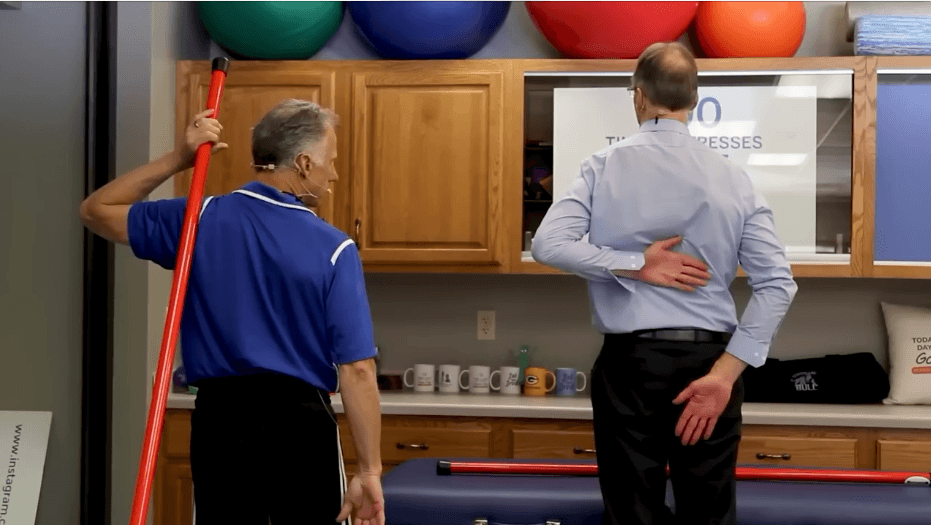
Brad: So, if the right arm has the impingement, the painful arc syndrome, you're going to put it down low. Now, if you do this with a stick other than the Booyah Stik, make sure it's slippery. It's got a smooth surface because you want to slide it on your shirt, because here's the problem right here. Typically, it's hard to reach up behind your back.
Bob: Yes, initially, you're probably going to be very limited if you compare the two, like the good one's going to be up quite a bit higher, the painful one's going to be only that far. So you're going to want to start working towards getting equal to the other side.
Brad: Yeah, and that's a motion you do every day with getting dressed, tucking your shirt in, taking your wallet out of your back pocket, and we need that.
Bob: Putting on your bra. Brad, I hope you haven't been doing that lately.
Brad: Well, Bob, I don't want to talk about it. We digress. We're going to go up.
Bob: We regress.
Brad: You're not going to go into the pain, you're just going to go up till it starts to hurt, and then go back down, up, stretch, gentle stretch, back down. Do that maybe 10 times and give it a break. And then come back and do it every couple of hours.
Bob: The advanced version of this would be, then you're going to work to the point where you're doing this, and you find this is getting pretty easy. Then you can actually bring it up and also bend the Booyah Stik or the stick forward. Not bending your body forward. You're keeping a good posture, but you're bending that arm forward. Don't hit your head. And this actually stretches it. And this really worked for me on an impingement. It worked.
Brad: Right.
Bob: I do it every morning yet. I do it preventively because it's funny, but when I forget to do it for a couple of days, it starts coming back. I feel it.
Brad: Well, you have to do the maintenance.
Bob: Yep.
Brad: There's one warning on this. If you're doing this, in particular if you're a larger person, and if you're using the broomstick, be careful so that it doesn't break. Because it could, you know, you'll never break a Booyah Stik.
Bob: Also, I don't want you doing this if your shoulders are prone to dislocation.
Brad: Well, that's a good point, Bob.
Bob: I don't want you doing it.
Brad: Again, it should not be painful, just a stretch. Wow. Now that was quite a comprehensive assessment as well as self-treatments for your shoulder. Now, if it happens that one of those is not working, we do want to complete and improve our offering for how to fix your shoulder. And we're going to go through the info from Rick Olderman, and go ahead, Mike. Carry on because I'm babbling.
Mike: Improve our offering. Anyway, I don't know why I find that funny. So what you can do is when you are sitting down, whether it's in a computer chair, standard chair, couch, or recliner, if you can give some extra support to your shoulder on the painful side, that can relieve a lot of tension you may be having in your upper trap or neck area. Oftentimes, people's shoulder blades can be depressed or down on the painful side. So if you see here, my arm rests are all the way down. This is going to put a lot of tension on my shoulders. If I just raise it up like this side.

Brad: But wait, but wait, Mike, let me explain that a little more for some people. If the weight of the arm and the shoulder are not being supported, it's like me pulling, the gravity pulling that whole shoulder blade down, stressing the muscle, stressing the shoulder. So we need support, but this is too short.
Mike: So we're going to raise it up as I have on this side. You can see the difference in my shoulder blade here, or my shoulder blade, my upper traps here, and how big of an angle they are. So just get them much more supported. Now, if people on a standard chair like Brad's can't adjust them, so what can you do?
Brad: Well, that's a good point. These are nice shoulder rests, but they're a little, they're kind of hard, and they're too low. Take a pillow right from your bed, fold it in half, and you're going to squish, scooch it in there, and there we have a nice shoulder rest that's soft, and it really supports the weight of that arm, elevating and taking the stress off those upper traps and that scapulator.
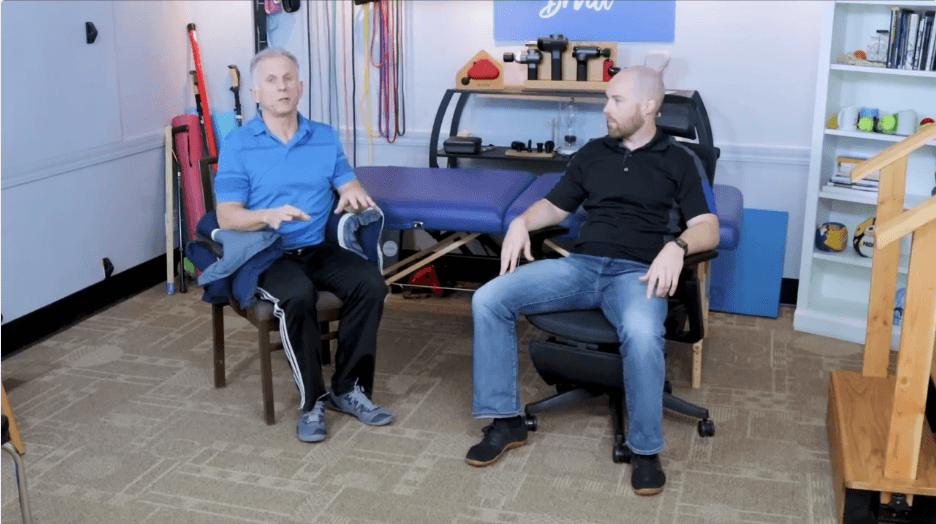
Mike: Scapulator? Now, if you're in a recliner or couch, and you have one armrest on that side, you can just try putting a pillow, maybe the long way across it, and just getting some more support there as well. That's just a good option. I realize sometimes you're on a couch, you don't have support on one side, so then you need a lot of pillows over there.

Brad: There you go. And if you are using this situation, I would recommend even if one shoulder's not painful, do it on both sides. Particularly if you're working at a workstation on a computer, you'll find it much nicer to work relaxed like this versus on a hard armrest or your arms dangling.
Mike: I want to know how many pillows you have at home.
Brad: Well, I have 27.
Mike: Did you count?
Brad: But yeah, some of them are old.
Mike: Anyway, if you want to check out more videos on shoulder pain, you can watch "Shoulder Pain? This Video Will Help 1,000’s of People."
Brad: That's right. Enjoy the day, and we hope those shoulders become pain-free.