%20(1).jpg)


This article is a transcribed, edited summary of a video Bob and Brad recorded in February 2025. For the original video, go to https://youtu.be/Pdr4xZJG8Eg
Mike: Ever wish you could fix your shoulder pain in seconds?
Brad: Yes.
Mike: Oh.
Brad: Well, I tell you what, you're in luck today because we are going to go take a trip down memory lane to give you a comprehensive list of options to fix your shoulder, and some of the best therapists in the world are going to be reviewed.
Mike: Make sure to stay tuned, because after that, we have a bonus tip we want you to try, and no exercise is required for that.
Brad: Yeah, that's right. I was just going to say the memory lane video has got, I think, over, it's got millions of views. A lot of positive comments.
Mike: Yeah, I think it's you guys, but maybe not. Anyway, should we time travel? You ready for your sound effect?
Brad: Here we go.
Bob: All right, so these are five exercises, and how you can do this in seconds is I just want you to do one of these exercises every few hours, and it only takes you seconds to do it.
Brad: Right.
Bob: You know, everybody's busy, nobody has time for pain. And that's it, it's interesting, I just had one of our aides, she hurt her knee. And she goes, "I don't have time for this." That's right, you don't have time for shoulder pain.
Brad: Right.
Bob: So, you don't have time to rehab it either. So, I'm going to show you things you can do throughout the day, maybe even in the office or wherever you work.
Brad: So, you're going to try all of these and only do the ones that are successful. Because more than likely, not all five will work on one person. It's usually one or two who are going to be successful. So, work with them.
Bob: Right, exactly. Find the ones that are working for you and then stick with them. And the thing that we're trying to treat here mainly is what we call impingement. Because impingement often leads to rotator cuff problems. And I'd say about 80% of the shoulders that we see are having this difficulty.
Brad: Right. As a matter of fact, our hanging book has studies saying this is the primary source of shoulder pain. Not all of it, but the majority.
Bob: So very quickly, we're going to show you what impingement is. So, it often occurs from a kind of poor posture, leaning forward like this or being hunched forward. And what that causes is you have the humeral head here, and it goes into the socket here, the glenoid fossa, and you have a tendon going over here. That's what this red thing is. And if there's not enough room in there, what's going to happen when you lift the arm? It pinches.
Brad: I'm going to show the healthy way is this: you have a gap in there.
Bob: You have plenty of room.
Brad: The joint drops down where it's supposed to. The rotator cuff is doing what it's supposed to. Unhealthy shoulder, ugh, pinch. And that's about where you get it is when your shoulder's around 90 degrees, it starts to pinch. "Ouch, ouch, ouch."
Bob: And what happens over time, you start to saw away at that tendon, and you can actually get a rotator cuff tear. You can tear the muscle. I mean, it just throws everything off.
Brad: Right.
Bob: These exercises are designed to get you a little more room in there.
Brad: Right, so we eliminate that impingement or that squeezing, pinching, nasty, owie painful stuff.
Bob: All right, the first one is the one that I've been doing. I actually, without going into too much detail, have a little bit of winging in this scapula, because I actually lost a muscle when I was younger. I had nerve damage.
Brad: Maybe you could go find it.
Bob: Yeah, maybe I could find it. So, this one tends to come forward more than the other ones. I have to do this every so often, I mean, this is something you do throughout the day. You want to do shoulder squeezes, and they're very easy to do. You can do them no matter where you are. You can do them standing, you can do them sitting.
Brad: Sure.
Bob: And I'm just going to go ahead and bend my elbows.
Brad: Yep.
Bob: And I'm going to squeeze my shoulder blades together.
Brad: You can see the wrinkling of his clothes, you know, showing that movement of the shoulder blades. And from this side.
Bob: Are you saying I just got my clothes out of the hamper?
Brad: Yeah, they're wrinkled. You need to get them taken in again to be pressed.
Bob: Yep, one, two, three, four, five, I usually do.
Brad: Is that what you count like that in your head?
Bob: One, two, three, four, five. Yeah.
Brad: Everyone's got their own little ways. I just go hold, and then it's kind of, that's my mantra. Hold.
Bob: Yeah. By strengthening these muscles, you're strengthening the core of the shoulder. And that helps if these are held back right here, it puts the shoulder in the right position.
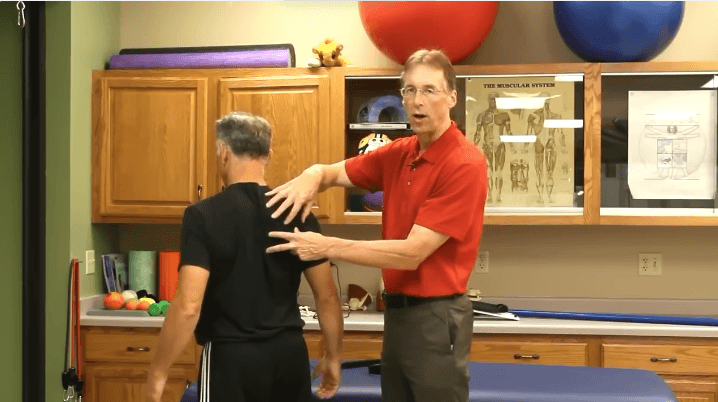
Bob: So instead of being rounded forward, they're back, and that's where you want them to be.
Brad: Right. They work much more efficiently and with less pain.
Bob: So, that's one I definitely want all of you to do. That's the one I want you to slip in throughout the day. The next one is the Mulligan technique, which we're a big fan of. And you can just do this off the back of a chair. And again, this helps set that humeral head down in the socket to give you more room for the tendon to glide through. So, I'm pushing down into the chair, and while I push down into the chair, I walk away, and this is my bad shoulder, so this is the one I should be doing it on.
Bob: And I can feel this actually stretch really well.
Brad: So, you're kind of pushing not straight down, but down and kind of towards your toes.
Bob: You hear that crack?
Brad: Oh, I didn't hear it, but I believe you. It's always louder to the person who has it, but you can see his range of motion. I did hear that. Audible crepitus. That's what we call it in the field.
Bob: We're trying again. And it's a sneaky way of getting more motion. And it's a sneaky way of getting more gap.
Brad: Right. With this technique, if you're unable to do this, but you do it without pain, it's the right thing. But if I've had some patients do this.
Bob: And they didn't like it.
Brad: Right. It's painful. It creates some sharp pain. If that's the case, that one goes off the list. We go to the next one.
Bob: Did you want to show it with the Booyah Stik?
Brad: Oh, sure. No, actually, why don't you want to, Bob?
Bob: Okay, so if you did have one of our Booyah Stiks, you could use the Booyah Stik, and you can actually, actually, you can do it one of two ways. You can walk away from it like this, or you can also push down and move it away like this. So either way, but it works out really well to walk away and push down the entire time.
Brad: Sure. You know, and it's something, if you don't have a Booyah Stik and you don't want to buy one, you know, you can, we've had people comment they're using the broom handle or something.
Bob: Yeah, absolutely.
Brad: You need to do it on carpet or something, so it sticks. That's what we have these nice rubber ends for.
Bob: Or the back of a chair, like we just did.
Brad: Sure.
Bob: So the next one is shoulder extension. So now we're going to start working on bringing the shoulder back, stretching this area out here again, making more room for the shoulder to do its job, to work correctly.
Brad: And we talked about people who had started these, Mulligan, he's a famous physical therapist. I think he's getting up there in age. I think he's still alive. He's got a whole system. This is the McKenzie technique.
Bob: McKenzie technique, too.
Brad: Yeah, and he's developed his own system that's widely popular in the therapy world worldwide.
Bob: So, we're working on increasing the amount that the arm goes back. Brad, I thought you showed really well on the countertop there.
Brad: So, you know, in the early phase when your shoulder's tight, you may just go up to the counter here and then get your good posture, and then you just squat gently. And right now, as I do that, that extends my shoulder, and you just go until you feel some pain, not much. Then you come off it. A little pain, off. So we go under pressure, but not into the pain. You never go into sharp pain.
Brad: When the range of motion starts to get better, and it's like, oh, this is getting much better, much less pain. Along with that, you're going to find that going in front is easier, but to increase it more, you open up the cupboard. Some people say we got a crooked cupboard door on here.
Bob: Yeah, we tried to fix that, too.
Brad: Yeah. So here we go. And now this is for high-level. This is for someone whose shoulder is really doing well, and they just want to get it to, you know, maybe they're a baseball thrower, or you know, a pitcher. Thrower. Yeah, I'm in it today, Bob.
Brad: So you can use other things in the household for stretching.
Bob: Yeah, things that just end up being the right level for you, go ahead and use it.
Brad: Sure.
Bob: All right, next one. Again, you don't need to do all these. I have all of you doing the shoulder squeezes. With the other ones, I would kind of find out which one seems to be working the best for you.
Brad: Right.
Bob: Decreasing your pain. This one's a really easy one. You just use a belt.
Brad: The reason we use a belt that is smooth and shiny is that you're going to do it with clothing, and you'll find out why in just a second here. Sometimes, if you have a little help to get it behind your back.
Bob: That's what I was trying to do.
Brad: Yeah. So the bottom arm is relaxed.
Bob: What I'm going to show you is that, quite often, what you're going to find is that the tight arm is limited and can't reach up very far. When I can put the other arm way up. And so I want to get this arm up to equal with that one. So, you're just going to go pressure on, pressure off. This belt really does work well. It takes a little bit of doing, but it slides really well.
Brad: Matter of fact, we did a video a number of years ago on a patient who was set up for shoulder surgery, and then she said, "Can I do therapy?" And the surgeon said, "Well, go ahead, you can do it." Within four visits, she was doing this exercise, no surgery needed.
Bob: Wow.
Brad: Her arm was going from 90 degrees to overhead, and she canceled the surgery. And I still see her, and it's still in good shape.
Bob: Wow, nice. There are some miracles every minute in the Bob and Brad clinic. Right?
Brad: There you go.
Bob: All right, the last one we're going to do is hanging. You're going to need some equipment. I mean, you need a place to hang.
Brad: Okay.
Bob: Brad and I have become big fans of this. Oh no, do we have our book around? You just need a hanging bar. And you're just simply going to relax and hang. And you know, when I first heard of this, I thought, this is crazy, it's going to make the impingement worse. But once I read the book, understood the mechanics, and started trying it, and we started working with people doing it, it's like, yeah, this can be really effective.
Bob: Yeah, we've become big fans. It's such an easy thing to do if you have the equipment, and you can wear gloves to help make it easier. So the book is "Shoulder Pain: The Solution and Prevention." It's by John M. Kirsch, MD.
Brad: Yeah, he's an orthopedic surgeon. As a matter of fact, he does his practice 30 miles from where I grew up in Wisconsin.
Bob: Does he really?
Brad: Yeah, Stevens Point.
Bob: Oh, cool. My daughter went to Stevens Point.
Brad: There you go. It's a nice town.
Bob: Yeah, it is.
Brad: Got a river running through it and everything. So, you're going to hang 10 to 30 seconds, depending on what you tolerate. Up to three repetitions of that, depending on how you respond to it. So the first time you do it might get sore, but after you do it for a few days, you'll be able to do this two to three times per day, and start the, we've really had good success with it.
Bob: And you still said seconds. Remember, we promised seconds, and yeah, so it's 30 seconds out of your day, and you can make it a great improvement.
Brad: All right, we are back. You just looked at some of the best therapists historically with Mulligan and McKenzie, but now we've got a new therapist that's got excellent information. His name is...
Mike: Rick Olderman, oftentimes, when he addresses shoulder pain, he looks at the shoulder blade itself or your scapula. And he has found that most people with shoulder problems have a depressed shoulder blade. And I am sitting like this to show an example of what that may look like. If my arm is just resting at my side or down here on a low surface, you could see how much more downward angle or tension I have on my shoulder muscles up here, my upper traps, and the rotator cuff. Everything, it doesn't function as well.

Mike: So, in order to eliminate some of the pain, simply raise an armrest if you happen to have a computer chair with an adjustable armrest.
Brad: Sure.
Mike: If you are seated on a normal chair or couch, we'll show what you can do as an example. So, you could see how much strain I may be having on some of these muscles before. And now, I am very relaxed, taking any pressure off of the shoulder area.
Brad: You just had a person in the clinic, you did this with, right?
Mike: I tested them out. There was more of a neck pain issue, but it all kind of connects.
Brad: Right. Basically the same concept.
Mike: Yes.
Brad: Now, if you have a chair and you work at your computer or sit, and you're finding your arms are too low, you want to elevate them up, take that stress off, even if you don't have a computer chair with adjustable armrests, take a pillow, fold it in half, kind of squish it in there. And there, it makes a really nice, comfortable armrest, taking the weight of that arm, elevating that shoulder like Mike just talked about. And it works well. You can do one on both sides. If this really works well, you're going to say either do this or eventually get a chair that has adjustable armrests. Whatever works. It takes the pain away, you'll like it.
Mike: If you happen to be on a couch or recliner, it typically has bigger armrests. You don't need to fold it up. You may just have to lay it sideways. And if you're traveling in your car, oftentimes you have an area to put your elbow on the door as well as on the middle console. Maybe that could take some pressure off if you're having shoulder pain while driving.
Brad: There you go, all right.
Mike: Now, if you're still having some issues with this and you want to check out more of Rick's methods, the next video coming up here is a lot of his techniques that we learned.
Brad: There you go, watch "Shoulder Pain? This Video Will Help 100's of People."