.webp)


This article is a transcribed, edited summary of a video Bob and Brad recorded in January 2024. For the original video, go to https://www.youtube.com/watch?v=kxRjwdz00g0
Brad: Believe it or not, this rolled-up sock is going to give you a solution for your neck posture, neck hump, and even hunchback.

Mike: We are going to show some of Bob's personal tips he used to help with any neck pain, as well as shoulder posture.
Brad: Plus, at the end, we're going to add a solution for the most stubborn neck hump issues.
Mike: Now we're going to take a trip down memory lane and go back in time, where Bob and Brad did a video on this topic. And a lot of the information is still relevant today.
Brad: That's right. It's very interesting. Are you ready to go back?
Mike: I am. Let's time-travel.
Bob: The object today, Brad, is how to get rid of a neck hump with a sock.
Brad: Oh.
Bob: Boy, isn't that intriguing, huh? Yeah, we have a sock right here.
Brad: Not just any sock, but a rolled-up sock.
Bob: That's right. A rolled-up kind of solid sock, so.
Brad: Yeah. Okay, we'll get into this trick in just a little bit.
Bob: So, neck hump, that's that big bump you see on some people. And it's often actually, even has a little bit of a fatty deposit.
Brad: Sure.
Bob: And it's called Dowager's Hump.
Brad: Dowager. Is that from a Doctor Dowager?
Bob: I'm sure it is. What else would it be? But, Brad's already putting the neck in the position, and he's showing you what is forming that bump. So if you go down, there are seven cervical vertebrae, and the seventh one is often the one that's the most prominent one that is sticking out. That little bump on the end is called the spinous process. You can see that bump right there sticking out.
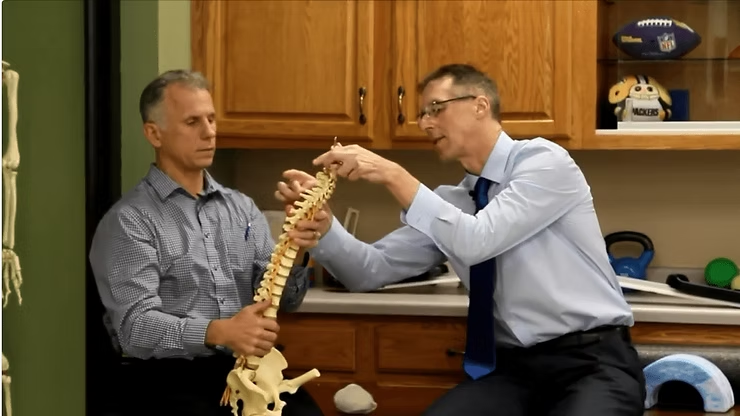
Bob: So, what we're going to do with the sock is we're going to provide counter pressure right there, right on that hump, to help correct that and move it back into place again.
Brad: Great. Yeah, because you know, there should be a little bit of an arch in there. I think it's safe to say everyone's seen people in public or whatever with that posture. You may know someone, or you may have it yourself. So, how can we correct that?
Bob: And better yet, how can we stop it from happening in the first place?
Brad: Sure.
Bob: So, you can do some of these exercises that are preventative if you started heading that way already.
Brad: Right.
Bob: So, I took a sock, actually, I took a pair of socks here, I guess you can call them.
Brad: Two of them. Yeah, yeah.
Bob: And I rolled up the first one, and I just took the second one and rolled it over the top of it. So, this one rolled this way, and this one I rolled right over the top.
Brad: Is this how you keep your socks in your drawer, or do you do the other method?
Bob: I just throw them in there.
Brad: Oh. All the same color, just throw them.
Bob: That's right.
Brad: You don't worry about matching.
Bob: Yeah. I think I'm good today. So, you got a nice, solid sock here. And now, this is going to provide the counterpressure. So you're going to need to be, where this works well for me is in my car. Now, I'm not going to recommend that you do it while driving.
Brad: No.
Bob: But, you can do it as a passenger, or you can do it before you start driving is do some of these exercises with the sock in place. Now, we don't have a high enough chair to do this to simulate driving. So, what we're going to do is we're actually going to take a chair, and we're going to take a foam roller.
Brad: You want to do it, Bob?
Bob: Yeah, I'll do it.
Brad: So, if you have a chair that has a tall enough back that goes to the top of your shoulders, you could use a firm chair. It's not going to work in a soft cushion chair. It has to be a firm chair. Or you can use a foam roller like this, and we're going to show you exactly how to do this.
Bob: So you put it right in place here, right at C7 there. And what I'm going to do is I'm going to do some chin tucks while it's in place, and it really, it really feels good.
Brad: Sure.
Bob: I mean, to be honest with you, this is the treatment I do in my car every day.
Brad: I've seen him do it, too.
Bob: I actually drive with this in place. My kids, the ongoing joke is, you know, I get in the car, my socks are not there. I'm going, where's my sock? And the kids know I won't leave until the sock is found.
Brad: I've seen him use a glove in the wintertime.
Bob: I've done the glove. I've done everything. So you do chin tucks, but you can also do, if this isn't in the way, you can actually do some extensions that way, Brad.
Brad: Sure.
Bob: And you can do some side bending. Back and forth, all that while keeping that sock in place and working on it.
Brad: Right. And if you notice, Bob's shoulders are back. The whole posture thing is the incentive. But Bob, what was I going to say? Repetition, people are going to do what? Five to 10 repetitions at a time?
Bob: Oh, I'd say at least. You could do more than that, even. You could do 15 to 20, I think, even. It's just one of those things that feels really good, and you almost can't get enough of it.
Brad: Right.
Bob: So obviously, if you don't have that, another way to do this is just on a hard surface. You could do it on the floor.
Brad: A carpeted floor is desirable. It just feels better.
Bob: Yeah. Tile would be tough. But this is not a floor, obviously, but we want to show you just so you can see it. This is a fairly hard surface. But, same thing, I can put it right in place here. Now, it's right on C7 again. And now, I can do my chin tuck with this in place.
Bob: And you could do some of your side bending this way, too, Brad.
Brad: Sure. Yep.
Bob: It feels really good.
Brad: All right, here we are. Back to the present. Anyway, actually, what happened, Bob continued to use his sock, but he wanted to come up with something even more aggressive for really working on that neck hump and that posture. And this is an actual device that Bob had come up with, and it's called the Posture Pad.

Brad: Now, the way it works, why don't you stand up and turn around, Mike? If you remember, he was putting the sock right here at about C7, and working posture pressure to improve the posture, get rid of that neck hump, that Dowager's hump.

Brad: So, instead of using that, we have this device here. You can sit down.
Mike: Oh, okay.
Brad: I'm going to actually go down. We're going down. All right. It's made to be on the floor. A carpeted floor is best. And actually, there's musculature between the shoulder blades and the spine that oftentimes knots up, associated with that hump. And that's why Bob came up with putting these tennis balls in there. They're actually different intensities. The light blue ones are softer. The dark blue ones are a little harder. And those are actually going to work into those tight muscles as I lie on them. And I can feel those balls right where they belong. You can adjust it, and then you just lie into it. And why don't you grab me a pillow, Mike?
Mike: I suppose I can.
Brad: When you first start this, it's going to be a little too aggressive. But right now, where that sock pressure was, the top of that incline, that posture pad is working. If I relax back, I can feel it, and I'm just simply using gravity. And as this gets more comfortable over time, I'm going to actually come back like this and roll back. And I can move up and down, and those tennis balls actually work into those knotted muscles. Relax them. That's a really typical way to get rid of knots, which is by pressure. Oh, we got something going on over there. Oh. All right.
Mike: Yes, sir.
Brad: Look right here. What do you see there?
Mike: I see a big edge.
Brad: Yeah, it's a radius edge. That's there for a specific reason. And that's so you can roll over that. You can easily take the balls out. I'm going to get more aggressive with that radius edge right at C7, where the sock was when we talked about that previously. There we go. And I'm just going to allow this to go back, support my head, so I don't plop down with hyperextension of the cervical column. And work with that. And then, you can work your arms up and over, and back and over. And back.
Brad: And you're going to spend a few minutes doing this. Again, the balls are optional. If you feel like they're working those knots out, you can use them. If not, you don't need to. And there you go. The posture pad works out very nicely.
Mike: Well, I would say that most people, if you do have a really stiff neck, the progression Brad showed may take weeks to months to go through. However, if you're just having a little bit of discomfort there, but you have good mobility of your neck and your upper spine, then you may progress as fast as Brad.
Brad: Right, yeah. Typically, if you really have that serious neck hump, that Dowager's hump, it's one of those things that doesn't eliminate within a week or so, but it gives you a nice option, something made specifically for it right there.
Mike: And if you don't like it, at least you got tennis balls that you can throw at people or your dog.
Brad: Oh, why Mike? Why?
Mike: We also have another video.
Brad: Oh, that's right. It's "Get Perfect Posture at Home or at Work". You know, that video was a nice one, I think that's the one I did with my wife.
Mike: It says you did it with your wife.
Brad: Yeah. If you want to meet my wife, she's on that video. We went through some wonderful posture things with her. Have a good day.