top of page

Add paragraph text. Click “Edit Text” to update the font, size and more. To change and reuse text themes, go to Site Styles.

Published On 
Time To Read
Share on Socials

Dec 26, 2025

3

More Resources

What Causes Your Knee to Click & When Do I Need to Worry

How To POP Your Sacroiliac Joint In Seconds (RELIEF)

Danger If My Shoulder Clicks and Pops? Learn Why & How to Fix

Popular Tags

Knee health

Knee Rehabilitation

lower body exercises

Bob and Brad Recommend

Bob and Brad TheraHeat Heated Knee Brace

$50.99

The first question you should ask is whether the “knee noise” needs fixing. It depends. In general, if the clicking, popping, or grinding is not accompanied by pain, swelling, locking, or weakness. You may hold off on seeing a clinician. If there is pain, swelling, locking, or weakness, you may want to choose to see a physician.


Treating the knee noise if accompanied by pain, swelling, locking, or weakness will depend on the type of problem you have. Here are some options for the following problems:


1. Cavitation:

a. At times, the noise you hear is due to a build-up and release of gas bubbles in your knee joint. When the bubbles burst, this is called cavitation.


2. Treatment:

a. This is truly a situation in which no solution is needed; however, there should not be any pain to accompany it.


3. Ligaments and tendons:

a. Some ligaments and tendons can “catch” as they slide over a bony bump and make a snapping sound as they snap back into place. An example of this can be the iliotibial band (IT Band) as it crosses over the bump on the outside of the knee while the knee bends and straightens. Over time, if the IT band gets irritated, it can result in pain.


Treatment:


Massage the Tensor Fascia Lata. Also, massage the IT Band. You will not be able to affect the band per se - but if it is adhered down, you may get it moving better.

(IT Band Area)


1. Cartilage tear:

a. A cartilage tear can occur with an injury or accident. A tear can also occur spontaneously as you age. If you have a piece of loose cartilage in your knee, it can block movement and/or cause popping and clicking. If cartilage is truly blocking the movement of the knee, you should see your doctor.

Treatment:


Strengthening of the quadricep may be in order (isometric over a pillow) – 5-second hold (3 x 10) 3 x per week.


Also, continuous movement (pain-free) can be tried - biking, FitGlide, swimming. Also, weight-bearing activities such as walking, Tai Chi, etc.


2. Osteoarthritis:

a. If the smooth cartilage that covers the end of your bones has worn down, flaked off, and/or become roughened, you may experience frequent clicking, popping, or grinding sounds. Clinicians may refer to this condition as “bone on bone”.

Treatment:


Strengthening of the quadricep may be in order (isometric over a pillow) – 5-second hold (3 x 10) 3 x per week.
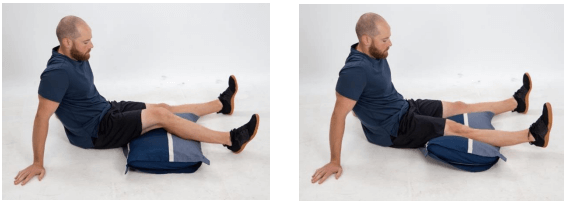

Also, continuous movement (pain-free) can be tried - biking, FitGlide, swimming. Also, weight-bearing activities such as walking, Tai Chi, etc.


3. Patellofemoral Pain Syndrome:

a. There is another joint between the kneecap and the end of the femur. The underside of the kneecap (patella) can get roughened up, and one can experience grinding, popping, or crunching. The kneecap may also not track correctly in the groove and resulting in the same sounds.


Treatment:


Stretch the kneecap in all 4 directions - DO NOT DO if you have a loose joint or rheumatoid arthritis. Strengthen hip external rotators - clam shell.

Scar tissue - if some of the soft tissue in or around your knee was injured and healed with scar tissue, that scar tissue can catch on surrounding surfaces and create joint noise.


Treatment:


Perform cross-fiber friction massage over the scarred area. 3-5 minutes (2-3x) a day. Back off on treatment if sore or nontolerant.


(Cross-Friction Massage Over Quadricep Tendon)


Check out the full Knee Pain Relief Program series of videos, along with downloadable guide sheets, here: https://www.bobandbrad.com/health-programs/knee-pain-relief-program


Bob and Brad discuss possible causes for clicking, popping, or creaking coming from the knee. They also demonstrate possible treatment options for each cause to help decrease knee pain.

How to Fix Your Knee From Clicking, Popping, or Creaking

How to Fix Your Knee From Clicking, Popping, or Creaking

How to Fix Your Knee From Clicking, Popping, or Creaking

The first question you should ask is whether the “knee noise” needs fixing. It depends. In general, if the clicking, popping, or grinding is not accompanied by pain, swelling, locking, or weakness. You may hold off on seeing a clinician. If there is pain, swelling, locking, or weakness, you may want to choose to see a physician.


Treating the knee noise if accompanied by pain, swelling, locking, or weakness will depend on the type of problem you have. Here are some options for the following problems:


1. Cavitation:

a. At times, the noise you hear is due to a build-up and release of gas bubbles in your knee joint. When the bubbles burst, this is called cavitation.


2. Treatment:

a. This is truly a situation in which no solution is needed; however, there should not be any pain to accompany it.


3. Ligaments and tendons:

a. Some ligaments and tendons can “catch” as they slide over a bony bump and make a snapping sound as they snap back into place. An example of this can be the iliotibial band (IT Band) as it crosses over the bump on the outside of the knee while the knee bends and straightens. Over time, if the IT band gets irritated, it can result in pain.


Treatment:


Massage the Tensor Fascia Lata. Also, massage the IT Band. You will not be able to affect the band per se - but if it is adhered down, you may get it moving better.

(IT Band Area)


1. Cartilage tear:

a. A cartilage tear can occur with an injury or accident. A tear can also occur spontaneously as you age. If you have a piece of loose cartilage in your knee, it can block movement and/or cause popping and clicking. If cartilage is truly blocking the movement of the knee, you should see your doctor.

Treatment:


Strengthening of the quadricep may be in order (isometric over a pillow) – 5-second hold (3 x 10) 3 x per week.


Also, continuous movement (pain-free) can be tried - biking, FitGlide, swimming. Also, weight-bearing activities such as walking, Tai Chi, etc.


2. Osteoarthritis:

a. If the smooth cartilage that covers the end of your bones has worn down, flaked off, and/or become roughened, you may experience frequent clicking, popping, or grinding sounds. Clinicians may refer to this condition as “bone on bone”.

Treatment:


Strengthening of the quadricep may be in order (isometric over a pillow) – 5-second hold (3 x 10) 3 x per week.


Also, continuous movement (pain-free) can be tried - biking, FitGlide, swimming. Also, weight-bearing activities such as walking, Tai Chi, etc.


3. Patellofemoral Pain Syndrome:

a. There is another joint between the kneecap and the end of the femur. The underside of the kneecap (patella) can get roughened up, and one can experience grinding, popping, or crunching. The kneecap may also not track correctly in the groove and resulting in the same sounds.


Treatment:


Stretch the kneecap in all 4 directions - DO NOT DO if you have a loose joint or rheumatoid arthritis. Strengthen hip external rotators - clam shell.

Scar tissue - if some of the soft tissue in or around your knee was injured and healed with scar tissue, that scar tissue can catch on surrounding surfaces and create joint noise.


Treatment:


Perform cross-fiber friction massage over the scarred area. 3-5 minutes (2-3x) a day. Back off on treatment if sore or nontolerant.


(Cross-Friction Massage Over Quadricep Tendon)


Check out the full Knee Pain Relief Program series of videos, along with downloadable guide sheets, here: https://www.bobandbrad.com/health-programs/knee-pain-relief-program


Comments


bottom of page